Safety
How do you use a marine VHF radio correctly?
Quick answer
A marine VHF radio, not a phone, is how a boat calls for help: channel 16 reaches every vessel in range and the Coast Guard at once, and DSC sends your exact position with one press only if the radio has its own GPS. A fixed 25 watt set reaches far farther than a 6 watt handheld.
A phone works until it does not: no signal offshore, no way to reach every other boat around you at the same moment, and no way to broadcast a position automatically the instant something goes wrong. A marine VHF radio solves all three, and it is built into the rules of the water in a way a phone call never can be. Every vessel monitoring channel 16 hears a distress call at the same time, including the Coast Guard, without anyone having to know a phone number to dial.
This guide covers the channel you actually need to know, what Digital Selective Calling does and what it needs to do it, the real difference in range between a handheld and a fixed mount set, and the exact format a distress call follows so it does not have to be improvised under pressure.
On this page
Why a phone is not a marine radio
A phone call reaches one person who has to already know who is calling and where. A VHF transmission on channel 16 reaches every vessel and every Coast Guard station monitoring that frequency within range, simultaneously, with no number to dial and no signal bars required beyond line of sight radio coverage. A phone also depends on a cell network that offshore water frequently does not have, while VHF works exactly as far offshore as line of sight and antenna height allow it to, independent of any carrier. Carrying a phone as a backup is reasonable. Treating it as your primary means of calling for help on the water is not.
The channels you actually need to know
Channel 16 is the one channel every vessel is expected to monitor, reserved for distress, safety and initial hailing before moving to a working channel.
Published figure A published engineering, regulatory or manufacturer figure. It does not change because somebody disagrees with it.
| Channel | Use |
|---|---|
| 16 | Distress, safety and calling. Monitor continuously. Move to a working channel once contact is made. |
| 9 | Alternate hailing channel used recreationally in some regions instead of tying up 16. |
| 13 | Bridge to bridge, navigation and lock coordination between vessels. |
| 22A | Coast Guard liaison, used after the Coast Guard directs you to it from channel 16. |
| 68, 69, 71, 72 | Non-commercial working channels for conversation once hailing is done. |
| 70 | Digital Selective Calling only. Not for voice traffic. |
The channel plan itself is published and regulated. Which working channel is busiest or most used varies by region and by season, which is convention learned locally rather than a fixed rule.
What DSC actually does, and what it needs to do it
Digital Selective Calling is the red button under a cover on most modern VHF sets, and pressing it sends a digital distress alert on channel 70 that includes your radio's registered identity and, critically, your position, automatically, to every DSC equipped station in range and to the Coast Guard. That last part only works if the radio actually knows where it is. A handheld or fixed set with its own built in GPS, such as Uniden UM725G fixed mount marine VHF with GPS, gets this right on its own. A fixed set without built in GPS needs a position fed to it over the boat's network from an external antenna such as Garmin GPS 24xd antenna and receiver, NMEA 2000, wired in over NMEA 2000. Skip that step and the DSC button still sends an alert, but it sends one with no position attached, which is close to the least useful version of an emergency call a modern radio can make.
Handheld versus fixed: the real range difference
A fixed 25 watt set with a masthead antenna typically reaches other vessels at roughly 20 to 25 nautical miles, several times farther than a 6 watt handheld held near the water.
Rule of thumb Boating and fishing convention rather than a published standard. Taught everywhere, useful, and not a specification. Nothing enforces it and no body publishes it.
| Radio type | Typical range to another vessel |
|---|---|
| 6 W handheld, held at deck or hand height | 4 to 8 nautical miles |
| 25 W fixed mount, masthead antenna | 20 to 25 nautical miles |
| Either radio to a tall shore or Coast Guard tower | Often well beyond either figure above |
These are commonly cited planning figures rather than a guaranteed range for any specific installation, since actual range depends on both antennas' height above the water and on atmospheric conditions that vary day to day.
Making a distress call: mayday, pan-pan and a routine call
- Mayday, for grave and imminent danger to life or the vessel. Switch to channel 16, key the mic and say "MAYDAY, MAYDAY, MAYDAY, this is [vessel name], [vessel name], [vessel name]," then give your position, the nature of the emergency, the number of people aboard, and a brief description of the vessel. Release the mic and listen for a response before repeating.
- Pan-pan, for urgent situations without immediate danger to life. Use "PAN-PAN, PAN-PAN, PAN-PAN" in place of mayday for situations that are urgent but not yet life threatening, such as a disabled engine drifting toward a hazard, followed by the same position, description and nature of the problem. This tells other vessels and the Coast Guard the situation is serious without triggering a full distress response.
- Securite, for a safety announcement rather than an emergency. "SECURITE, SECURITE, SECURITE" precedes a broadcast that is informational rather than an emergency, such as a hazard to navigation or an approaching storm you want other vessels nearby to know about.
- Routine hailing, for everyday contact between vessels. Hail the other vessel by name on channel 16 or a regional alternate hailing channel, agree on a working channel together, then move both radios off 16 to continue the conversation so the distress channel stays clear for anyone who actually needs it.
- Press DSC first when the radio has a distress button. On a radio with a covered DSC distress button, press and hold it before or immediately after keying up on channel 16 by voice. The digital alert reaches DSC equipped stations even if your voice transmission is not clearly heard, and it carries your position automatically if the radio has one.
Choosing a handheld radio

Uniden Atlantis 155 handheld VHF, floating and submersible
$67.99IPX8 submersible and floating at a price that makes carrying a spare aboard an easy decision.
Best for: A first handheld, or a backup to a fixed set
Check price on Amazon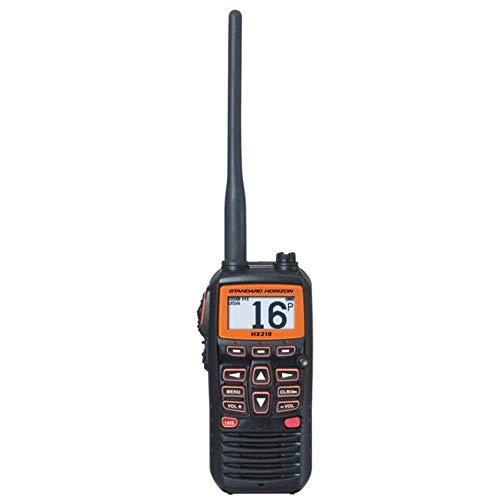
Standard Horizon HX210 6W floating handheld VHF
$114.25Full legal 6 watt handheld power rather than the 1 or 2.5 watt low modes cheaper units default to, and it floats.
Best for: A kayak or small boat with no fixed radio at all
Check price on Amazon
Icom M25EVO floating marine VHF radio
$161.90The lightest genuinely capable handheld here, from a maker that builds commercial marine radios as its actual business.
Best for: Anyone who wants a handheld light enough to clip on and forget
Check price on AmazonChoosing a fixed mount radio
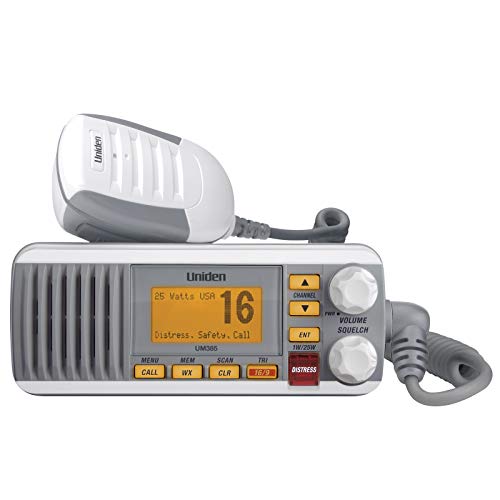
Uniden UM385 25W fixed mount marine VHF with DSC
$107.99 Published specsTwenty five watts with DSC distress send and receive at close to the price of a decent handheld.
Best for: The first fixed radio on a boat that goes out of sight of the ramp
Check price on Amazon
Standard Horizon GX1410 Eclipse 25W fixed mount VHF
$138.15A compact 25 watt fixed set with Class D DSC, sized for a console with limited room.
Best for: A smaller helm that still wants a real fixed antenna and full power
Check price on Amazon
Uniden UM725G fixed mount marine VHF with GPS
$158.75 Published specsBuilt in GPS, which is what makes the DSC distress button send an actual position without wiring in a separate antenna.
Best for: Anyone who wants DSC to work correctly without adding a network antenna
Check price on AmazonHow we chose
We did not test this equipment in person and we never claim to. Picks are researched from manufacturer specification sheets, published engineering and regulatory figures, and the recurring themes in verified owner reviews. Every pick is matched to a real thrust rating, a real published amp draw, a real capacity or a real conductor size rather than to a price bracket, and it is placed in the tier where its published capability actually belongs. We rejected the unbranded flood that dominates several of these search results, because a lithium pack whose management board is the only thing between a cell fault and a fire, a breaker protecting a battery cable, a life jacket and a bracket holding a two thousand dollar motor to the bow at highway speed are all parts whose failure has a consequence nobody can walk away from. Where a figure is convention rather than a published standard we label it that way, and where a manufacturer does not publish a figure we leave it out instead of estimating it.
Frequently asked questions
What is the single most important channel to know on a marine VHF radio?
Channel 16, monitored continuously by other vessels and the Coast Guard for distress and initial hailing. Every marine VHF radio defaults to it or has a dedicated button to jump straight there. Once contact is made or a distress call is answered, both parties move to a working channel to keep 16 clear for anyone else who needs to reach it, but 16 is always the channel you start on.
Does DSC work without GPS?
The distress alert itself still transmits without GPS, carrying your radio's registered identity to other DSC equipped stations, but it sends no position with it. The entire advantage of DSC over a plain voice mayday call is that it delivers your location automatically, so a radio without its own GPS or an external antenna feeding it a position is missing the single most useful part of the feature.
Is a 6 watt handheld enough for a small lake or should I get a fixed radio?
A 6 watt handheld covers a small lake and inland water reasonably well, and its low cost and portability make it a sensible primary radio for a kayak or small boat that has nowhere obvious to mount a fixed set with a proper antenna. A fixed 25 watt set becomes worth the installation once you are running open water, out of sight of land, or regularly far enough from other boats that the extra range genuinely changes whether a call gets heard.
What happens if I press the DSC distress button by accident?
Cancel it immediately by broadcasting a voice message on channel 16 stating your vessel name and that the alert was sent in error, since an unanswered false distress alert can trigger a genuine search response from the Coast Guard. Most radios also have a cancel sequence in their own menu for an accidental press, which is worth knowing before you ever need the real button.
Can I use my marine VHF radio to call a phone number?
Only through a marine operator service where one still exists, which is increasingly rare and not something to plan a safety strategy around. A marine VHF radio is built for vessel to vessel and vessel to Coast Guard communication, not as a general substitute for a phone, and treating it as one is a good way to be unfamiliar with the channels and call formats that actually matter in an emergency.
Do I need a license to operate a marine VHF radio?
Recreational boaters operating domestically generally do not need an individual operator license or a ship station license for a VHF radio used on non-commercial voyages within domestic waters. Requirements change for vessels required to carry a radio, vessels traveling to foreign ports, or commercial use, so check current requirements for your specific vessel and planned waters before assuming none apply.
Get the complete rigging shopping list
Every item in the beginner, intermediate and expert rigs for both a boat and a kayak, with running totals, in one printable list. No charge.
One list, no sequence of daily emails, and you can leave at any time.
Researched, not professional advice. This page is compiled from published engineering and regulatory figures, manufacturer specifications and owner-review consensus, not hands-on testing. Figures described as a rule of thumb are boating convention rather than published standards, and they are labelled that way wherever they appear. Marine electrical work is not house wiring. Use tinned, finely stranded marine cable, size it for voltage drop and for the ABYC E-11 ampacity table rather than one or the other, and put overcurrent protection within seven inches of the battery positive terminal, because everything between the post and the fuse is unprotected. A lithium battery needs a charger with a lithium profile. Never load a boat past its capacity plate, and remember that canoes and kayaks carry no federal capacity plate at all, so their stated capacity is the manufacturer own figure. Wear the life jacket, and treat early season water as the hazard it is: cold water immersion takes your breath and then your hands long before it takes your core.