Batteries
Which 36 volt trolling motor battery bank should you buy?
Quick answer
A single 36 volt lithium pack replaces three 12 volt batteries wired in series, cutting the interconnect cables, the second and third boxes, and a large share of the weight those three batteries add. The LiTime 36V 50Ah is the cheapest entry point, and the LiTime 36V 100Ah is sized for a full day on a 112 lb thrust motor.
A 36 volt trolling motor bank has always meant three 12 volt batteries wired in series, and it still can. What changed is that a single 36 volt lithium pack now does the same job from one box, with one set of terminals instead of two interconnect cables that are themselves a maintenance item most owners never think about until one corrodes.
The published weights make the case for lithium here better than a sales pitch does. The LiTime 36V 50Ah TM LiFePO4 battery with low temperature protection weighs 33.14 lb by the manufacturer's own figure, while a Group 31 AGM like the VMAX MR137-120 12V 120Ah AGM Group 31 battery publishes 75 lb on its own, and a series bank needs three of those to reach 36 volts. That is not an equal amp hour swap, since three 120 Ah batteries in series still deliver 120 Ah at 36 volts and the LiTime pack is rated 50 Ah, but it puts a real number on why anglers replacing a full 36 volt bank talk about the weight difference first.
Every capacity, charger bundle and price below comes from each product's own Amazon listing, checked against the manufacturer's stated specifications.
On this page
- How this list was put together
- Should I buy one 36 volt pack or three 12 volt batteries in series?
- Does a 36 volt lithium bank need a different charger than a series lead acid bank?
- What actually needs 36 volts in the first place?
- Best budget 36 volt lithium battery
- Best 36 volt lithium battery for most anglers
- Best high capacity 36 volt lithium battery
How this list was put together
None of these battery banks were installed on a boat to confirm the manufacturer's numbers. Every specification below comes from each product's own listing, checked against the maker's stated figures rather than assumed from a similar-looking model, because a mismatched charger or an undersized pack is a safety and reliability problem here, not just a shopping mistake.
Should I buy one 36 volt pack or three 12 volt batteries in series?
The LiTime 36V 50Ah pack publishes a weight of 33.14 lb, against 75 lb for a single Group 31 AGM before multiplying by three for a series bank.
Published figure A published engineering, regulatory or manufacturer figure. It does not change because somebody disagrees with it.
| Option | Rated capacity | Published unit weight | Batteries needed for 36V |
|---|---|---|---|
| LiTime 36V 50Ah lithium pack | 50 Ah at 36V | 33.14 lb | 1 |
| VMAX MR137-120 Group 31 AGM | 120 Ah at 12V each | 75 lb each | 3, wired in series |
These are not an equal amp hour comparison. Three 120 Ah batteries in series still total 120 Ah at 36 volts, well above the 50 Ah lithium pack's rating, and lithium also delivers a larger share of its rated capacity at a hard discharge than lead acid does. The weight figures are each product's own published number.
Does a 36 volt lithium bank need a different charger than a series lead acid bank?
Yes, and the difference matters more here than on a single 12 volt battery because a 36 volt bank is usually charged through a three bank charger regardless of chemistry. A three bank charger built for lead acid will not carry a lithium profile on any of its banks, so a LiTime 36V pack bundled with a matching 15A charger removes the guesswork entirely by shipping the correct charger with the battery. Buying the pack and the Minn Kota MK-345PCL separately works just as well, as long as the lithium profile is actually selected on all three banks rather than left on the default lead acid setting.
What actually needs 36 volts in the first place?
Minn Kota and MotorGuide's own lineups tie voltage to thrust rather than leaving it a free choice: 30 to 55 lb thrust motors run on 12 volts, 70 to 80 lb thrust motors run on 24 volts, and 101 to 112 lb thrust motors are the ones that actually require 36 volts. Buying a 36 volt bank for a motor rated at 55 lb thrust does not make it push harder, since the motor's own control electronics are built for a specific voltage window.
Best budget 36 volt lithium battery
The cheapest genuine way into a single 36 volt lithium pack, before adding a matching charger or Bluetooth monitoring.
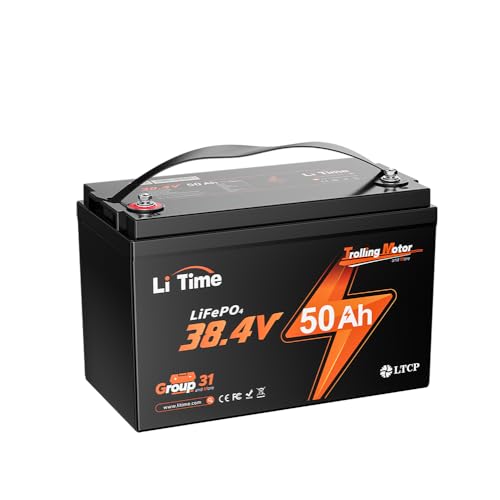
LiTime 36V 50Ah TM LiFePO4 battery with low temperature protection
$439.99 Published specsThe cheapest genuine way into a single 36 volt pack, and 50 Ah of lithium is closer to three lead acid batteries worth of usable capacity than the number alone suggests.
Best for: A first 36 volt lithium purchase on a fixed budget
Check price on AmazonBest 36 volt lithium battery for most anglers
A bundled charger or a second established brand removes the two biggest risks of a first 36 volt lithium purchase.

LiTime 36V 50Ah Bluetooth lithium trolling motor battery with 15A charger
$647.99 Published specsBundled with a matching 15A lithium charger, which removes the most common and most expensive mistake a first 36 volt lithium buyer makes.
Best for: Anyone who does not already own a charger with a lithium profile
Check price on Amazon
Power Queen 36V 50Ah LiFePO4 battery
$429.99 Published specsA second established brand at the same 50Ah rating, useful where LiTime stock or price moves against a buyer.
Best for: Buyers who want a named alternative to LiTime at the same capacity
Check price on AmazonBest high capacity 36 volt lithium battery
A full tournament day on the largest bow motors is the one case where doubling the amp hour rating actually earns its price.

LiTime 36V 100Ah lithium battery with 25A charger
$1,044.99 Published specs100 Ah at 36 volts with a bundled 25A charger, enough for a full tournament day on a 112 lb thrust motor.
Best for: Full day use on the largest bow motors
Check price on AmazonWho should not buy this tier: Anyone whose motor draw and hours on the water do not justify it. A 50 Ah pack covers most fishing days, and the 100 Ah pack roughly doubles the price for capacity that mostly sits unused.
How we chose
We did not test this equipment in person and we never claim to. Picks are researched from manufacturer specification sheets, published engineering and regulatory figures, and the recurring themes in verified owner reviews. Every pick is matched to a real thrust rating, a real published amp draw, a real capacity or a real conductor size rather than to a price bracket, and it is placed in the tier where its published capability actually belongs. We rejected the unbranded flood that dominates several of these search results, because a lithium pack whose management board is the only thing between a cell fault and a fire, a breaker protecting a battery cable, a life jacket and a bracket holding a two thousand dollar motor to the bow at highway speed are all parts whose failure has a consequence nobody can walk away from. Where a figure is convention rather than a published standard we label it that way, and where a manufacturer does not publish a figure we leave it out instead of estimating it.
Frequently asked questions
Is one 36 volt lithium battery really equivalent to three 12 volt lead acid batteries?
Not amp hour for amp hour, no, and a straight swap needs checking. Three 12 volt batteries wired in series add their amp hour rating together at 36 volts, while a single lithium pack is rated on its own. Lithium delivers a much larger share of that rating at a hard discharge than lead acid does, so a 50 Ah lithium pack often covers a day that would need noticeably more lead acid capacity to match.
Can I use a single bank onboard charger to charge a 36 volt battery?
No. A single bank charger is built for one 12 volt battery, and a 36 volt system, whether it is one lithium pack or three lead acid batteries in series, needs a charger designed for that voltage or a bank set up per battery. A three bank 12 volt charger works on a series lead acid bank because it charges each battery individually before they are wired together as 36 volts for the motor.
Does a 36 volt lithium pack need a charger with a lithium profile just like a 12 volt one does?
Yes, without exception. The voltage is different but the chemistry inside is the same LiFePO4, and a lead acid profile causes the same problems at 36 volts as it does at 12: either it never reaches the bulk voltage the pack needs, or it holds the pack at a float voltage lithium cells should not sit at. Buying a pack bundled with a matching charger, like the LiTime models that ship with one, removes this risk entirely.
Why do some 36 volt trolling motors need 100 Ah and others only need 50 Ah?
Motor draw and hours on the water decide it, not the thrust rating alone. A 101 or 112 lb thrust motor run hard for a full tournament day pulls enough current that a 50 Ah pack may not last, while the same motor used for a few hours of casual fishing rarely comes close to emptying it. Running the actual draw and planned hours through a runtime calculator before buying the larger pack avoids paying for capacity that sits unused.
What is the weight difference between a 36 volt lithium pack and three Group 31 AGM batteries?
Using published figures, a LiTime 36V 50Ah pack weighs 33.14 lb, while a single VMAX MR137-120 Group 31 AGM weighs 75 lb, and a series bank needs three of those to reach 36 volts. The comparison is not a perfectly equal amp hour swap, since three 120 Ah batteries total more rated capacity than the 50 Ah lithium pack, but it puts a real number on the weight difference anglers ask about most.
Do I need to rewire anything when switching from three 12 volt batteries to one 36 volt pack?
The series interconnect cables between the three batteries come out entirely, along with two of the three boxes or trays, since the single pack replaces all of it in one case. The main feed to the motor, the fuse near the battery post and the on-off switch stay in the circuit and generally do not need to change size, though it is worth confirming the fuse rating against the motor's published draw either way.
Get the complete rigging shopping list
Every item in the beginner, intermediate and expert rigs for both a boat and a kayak, with running totals, in one printable list. No charge.
One list, no sequence of daily emails, and you can leave at any time.
Researched, not professional advice. This page is compiled from published engineering and regulatory figures, manufacturer specifications and owner-review consensus, not hands-on testing. Figures described as a rule of thumb are boating convention rather than published standards, and they are labelled that way wherever they appear. Marine electrical work is not house wiring. Use tinned, finely stranded marine cable, size it for voltage drop and for the ABYC E-11 ampacity table rather than one or the other, and put overcurrent protection within seven inches of the battery positive terminal, because everything between the post and the fuse is unprotected. A lithium battery needs a charger with a lithium profile. Never load a boat past its capacity plate, and remember that canoes and kayaks carry no federal capacity plate at all, so their stated capacity is the manufacturer own figure. Wear the life jacket, and treat early season water as the hazard it is: cold water immersion takes your breath and then your hands long before it takes your core.