Wiring and protection
Marine wire gauge and voltage drop calculator
Quick answer
Carrying 50 amps over a 20 foot run at 12 volts inside the ABYC three percent drop limit needs 2 AWG. The run length doubles in the calculation because current flows out along the positive and back along the negative, and forgetting that halves every answer.
Two things decide a conductor size on a boat, and this calculator answers one of them. Voltage drop is the one that usually binds on a long trolling motor run, and it is pure arithmetic with a published constant.
Ampacity is the other half: the current a conductor can carry without overheating. It depends on the insulation temperature rating, on whether the run passes through an engine space, and on how many current carrying conductors are bundled together. A cable has to satisfy both, and we deliberately publish no ampacity figure, for reasons set out below.
Size your own run
50 amps over 20 feet at 12 volts needs 2 AWG to hold three percent drop. Check the E-11 ampacity table separately.
| Figure | Value |
|---|---|
| Conductor length (round trip) | 40 ft |
| Allowed drop | 0.4 V |
| Circular mils required | 59,722 |
| Smallest gauge that holds it | 2 AWG |
| Actual drop at that gauge | 0.3 V |
| Ampacity | not published, see below |
Shown with the example figures above. Change any field to run your own numbers.
The working
Published figurerequired circular mils = ( 2 x K x amps x length ) / allowed drop volts K = 10.75 circular mil ohms per foot for copper the 2 is the ROUND TRIP: out on positive, back on negative allowed drop volts = system volts x 0.03 (ABYC critical circuit) = system volts x 0.10 (ABYC non-critical)
The formula, the copper constant and the AWG circular mil table are published. The three and ten percent limits come from ABYC E-11. A published engineering, regulatory or manufacturer figure. It does not change because somebody disagrees with it.
Cable, connectors and protection
Marine cable is tinned and finely stranded for reasons that decide how long the install lasts. Size the gauge from the answer above and check it against the ABYC E-11 ampacity table for your own insulation and location.

Ancor Marine Grade single crimp ratchet tool
$70.13Ancor is the marine wiring reference brand, and a ratchet crimper will not release until the crimp is fully formed, which removes the commonest failure.
Best for: Anyone doing more than one connection properly
Check price on Amazon
Blue Sea Systems ST Blade fuse block, 12 circuits with negative bus
$42.00Twelve circuits, which is what a boat ends up needing once the electronics, lights, pumps and charger all want their own fuse.
Check price on Amazon
Klein Tools 3005CR ratcheting wire crimper, 10 to 22 AWG
$34.96A ratcheting crimper from a tool company, for the small gauge terminals that make up most of a boat harness.
Check price on Amazon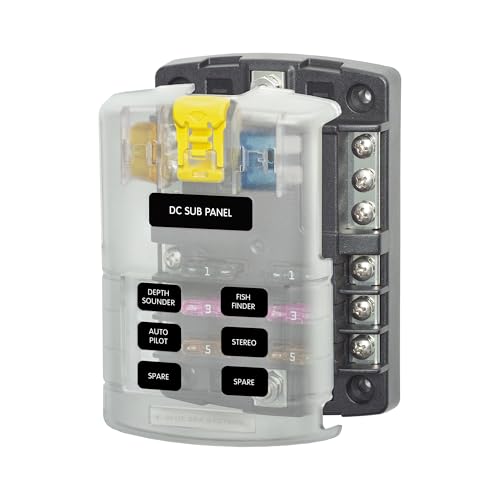
Blue Sea Systems ST Blade fuse block, 6 circuits with negative bus
$31.15Six fused positives and a common negative in one block, which is the whole electrical panel on a small fishing boat.
Best for: A first proper distribution panel, replacing inline fuses taped behind the console
Check price on Amazon
iCrimp AP-50BI battery cable lug crimper, 8 to 2 AWG
$28.59Heavy cable lugs need a different tool entirely from terminal crimpers, and this is the cheap way to get a proper hex crimp on battery cable.
Best for: Making up your own trolling motor cables
Check price on Amazon
haisstronica heat shrink butt connectors, 330 piece, 26 to 10 AWG
$23.79Adhesive lined heat shrink over a tinned barrel, in the full range of sizes, which covers essentially every joint on a small boat.
Check price on AmazonEvery figure shown is the manufacturer own published specification. The rating on the unit you receive is what governs, and the capacity plate on your own boat governs everything above it.
On this page
The round trip is the part people forget
Current leaves along the positive conductor and returns along the negative, so the conductor length in the calculation is twice the run length. A 20 foot run is 40 feet of copper as far as resistance is concerned.
Leaving the factor of two out is the single commonest error in marine wire sizing, and it halves every answer in exactly the direction that produces a cable which runs warm. Measure the run as the path the cable actually takes rather than the straight line: a bow motor feed that is 14 feet in a straight line routinely measures 20 once it has gone round the console and under the deck.
Three percent or ten percent
ABYC E-11 uses three percent where voltage matters and ten percent where it does not, and a trolling motor feed is treated as a three percent circuit here.
Published figure A published engineering, regulatory or manufacturer figure. It does not change because somebody disagrees with it.
| Limit | Circuits it applies to | At 12 V | At 24 V | At 36 V |
|---|---|---|---|---|
| 3 percent | Panel feeds, electronics, navigation lights, bilge blowers, and anything where voltage matters | 0.4 V | 0.7 V | 1.1 V |
| 10 percent | General lighting and accessories where a small voltage loss changes nothing | 1.2 V | 2.4 V | 3.6 V |
A trolling motor will physically run at ten percent drop. It will simply deliver less of the battery you paid for to the water, and the cable is the cheapest part of the system to get right once, which is why we size motor feeds at three percent.
What each gauge drops
Going up one gauge cuts the drop by roughly a fifth, and doubling the conductor area halves it.
Published figure A published engineering, regulatory or manufacturer figure. It does not change because somebody disagrees with it.
| Gauge | Circular mils | Drop at 50 A over 20 ft | Percent of 12 V |
|---|---|---|---|
| 16 AWG | 2,580 | 8.3 V | 69.4% |
| 14 AWG | 4,110 | 5.2 V | 43.6% |
| 12 AWG | 6,530 | 3.3 V | 27.4% |
| 10 AWG | 10,380 | 2.1 V | 17.3% |
| 8 AWG | 16,510 | 1.3 V | 10.9% |
| 6 AWG | 26,240 | 0.8 V | 6.8% |
| 4 AWG | 41,740 | 0.5 V | 4.3% |
| 2 AWG | 66,360 | 0.3 V | 2.7% |
| 1 AWG | 83,690 | 0.3 V | 2.1% |
| 1/0 AWG | 105,600 | 0.2 V | 1.7% |
| 2/0 AWG | 133,100 | 0.2 V | 1.3% |
| 3/0 AWG | 167,800 | 0.1 V | 1.1% |
| 4/0 AWG | 211,600 | 0.1 V | 0.8% |
Circular mil areas are the American Wire Gauge standard. The drop is calculated with the published copper constant of 10.75 circular mil ohms per foot.
Marine cable is genuinely different
Use tinned, finely stranded marine cable rather than automotive wire, and the difference is not marketing. Tinning stops the copper corroding from the inside, where nothing shows on the outside until the connection heats up. Fine stranding survives constant vibration without work hardening and breaking inside the insulation.
Neither difference is visible in a photograph, and both decide how long the installation lasts. Crimp with a ratchet tool, which will not release until the crimp is fully formed, and seal every joint with adhesive lined heat shrink.
Protect it at the battery
ABYC E-11 puts overcurrent protection within 7 inches of the point the conductor connects to the battery, extended to 40 inches when the conductor runs inside a sheath or enclosure.
The reason is simple and worth stating plainly: everything between the battery post and that device is unprotected, and a battery can deliver enough current into a chafed cable to set fire to the boat before anything else in the system notices.
Frequently asked questions
What gauge wire do I need for a trolling motor?
It depends on the current and the run length, not on the motor name. Fifty amps over a 20 foot run at 12 volts needs 2 AWG to hold the ABYC three percent drop limit. The same 50 amps over 10 feet needs 4 AWG. Measure the path the cable actually takes rather than the straight line distance, because they differ substantially.
Why does the run length double in the formula?
Because current has to get back. It flows out along the positive conductor and returns along the negative, so a 20 foot run is 40 feet of copper as far as resistance is concerned. Forgetting the round trip is the commonest error in marine wire sizing and it halves every answer, in exactly the direction that produces a cable which runs warm.
Can I use ten percent drop instead of three?
ABYC E-11 allows ten percent on circuits where voltage does not matter, and requires three percent where it does: panel feeds, electronics, navigation lights and bilge blowers. A trolling motor will run at ten percent drop. It will simply deliver less of the battery you paid for to the water, which is why we size motor feeds at three.
Why does this calculator not give me an ampacity?
Because a single ampacity number indexed by gauge would be wrong for most installations. ABYC E-11 ampacity depends on the insulation temperature rating, on whether the run passes through an engine space, and on how many current carrying conductors are bundled together. We would rather send you to the real table than print a figure that could overheat a cable.
Is marine wire really different from automotive wire?
Yes, in two ways that both matter. Marine cable is tinned, which stops the copper corroding from the inside where nothing is visible until the connection heats up. And it is far more finely stranded, so it survives vibration without work hardening and breaking inside the insulation. Neither shows in a photo and both decide how long the install lasts.
Does a bigger gauge cause any problem?
Electrically, no. Larger conductors drop less voltage and run cooler, and a size up is cheap insurance on a run you do not want to redo. The practical limits are cost, weight, and whether the cable will physically bend into the route and fit the lugs and terminals at each end, which on heavy battery cable is a real constraint rather than a theoretical one.
Get the complete rigging shopping list
Every item in the beginner, intermediate and expert rigs for both a boat and a kayak, with running totals, in one printable list. No charge.
One list, no sequence of daily emails, and you can leave at any time.
Researched, not professional advice. This page is compiled from published engineering and regulatory figures, manufacturer specifications and owner-review consensus, not hands-on testing. Figures described as a rule of thumb are boating convention rather than published standards, and they are labelled that way wherever they appear. Marine electrical work is not house wiring. Use tinned, finely stranded marine cable, size it for voltage drop and for the ABYC E-11 ampacity table rather than one or the other, and put overcurrent protection within seven inches of the battery positive terminal, because everything between the post and the fuse is unprotected. A lithium battery needs a charger with a lithium profile. Never load a boat past its capacity plate, and remember that canoes and kayaks carry no federal capacity plate at all, so their stated capacity is the manufacturer own figure. Wear the life jacket, and treat early season water as the hazard it is: cold water immersion takes your breath and then your hands long before it takes your core.