Sonar and displays
Sonar cone coverage calculator
Quick answer
A 20 degree cone in 15 feet of water covers a circle about 5.3 feet across, which is roughly 22 square feet of bottom. Coverage scales directly with depth, so in 10 feet the same transducer sees only a 3.5 foot circle. This is why imaging earns its money in shallow water.
Sonar coverage is a cone opening downward from the transducer, which means the shallower the water, the less bottom it sees. It is pure trigonometry with one input the calculator cannot supply: the cone angle, which belongs to your own transducer at the frequency you are running.
Most people are surprised by the answer the first time. A boat moving at four miles an hour over a 3.5 foot circle of visibility is missing nearly everything it passes, and that gap is the entire commercial case for side imaging, down imaging and live sonar.
Run your own numbers
A 20 degree cone in 15 feet covers a circle 5.3 feet across, which is about 22 square feet of bottom.
| Figure | Value |
|---|---|
| Coverage diameter | 5.3 ft |
| Coverage area | 22 sq ft |
| Coverage at half this depth | 2.6 ft |
| Coverage at twice this depth | 10.6 ft |
| Depth needed for a 10 ft circle | 28.4 ft |
| A 60 degree beam here would cover | 17.3 ft |
Shown with the example figures above. Change any field to run your own numbers.
The working
Published figurecoverage diameter = 2 x depth x tan( cone angle / 2 ) depth = 15 ft, cone = 20 degrees diameter = 2 x 15 x tan(10) = 5.3 ft area = pi x ( diameter / 2 ) ^ 2
Pure trigonometry. The only figure here that is not is the cone angle itself, which is a property of your own transducer at the frequency you are running. A published engineering, regulatory or manufacturer figure. It does not change because somebody disagrees with it.
Transducers and units
The screen only draws what the transducer hears, which is why an upgrade here frequently beats an upgrade there. Cone angles are published per transducer and per frequency.

Garmin Airmar B150M thru-hull with 20 degree tilt
$477.13A tilted element bronze thru-hull, which keeps the beam vertical on a hull with real deadrise instead of pointing it sideways.
Check price on Amazon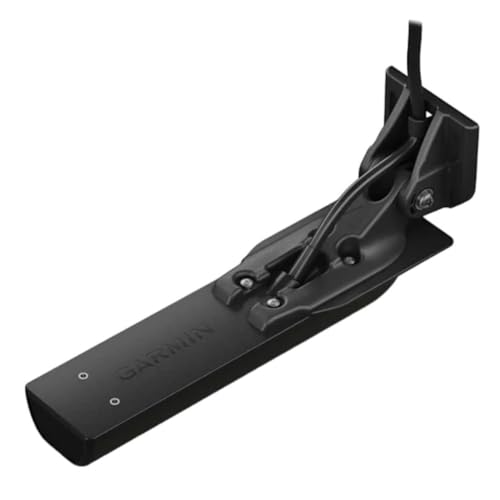
Garmin GT56UHD-TM transom mount transducer
$468.83Ultra high definition ClearVu and SideVu, and the transducer the nine inch ECHOMAP units ship with.
Check price on Amazon
Garmin GT54UHD-TM transom mount transducer
$396.71The 800 kHz ClearVu and SideVu transducer that the seven inch ECHOMAP units carry, and a real upgrade over a GT20.
Check price on Amazon
Garmin Striker Vivid 5cv
$349.99 Published specsThe five inch screen is the first size where a split screen of traditional and ClearVu is genuinely readable.
Best for: Anyone who found a four inch split screen too small to use
Check price on Amazon
Garmin GT34UHD-TM transducer
$249.99Ultra high definition scanning without the side imaging element, for a boat where down imaging is what gets used.
Check price on Amazon
Garmin GT23M-TM transducer
$239.99Mid band CHIRP with ClearVu, and the sensible replacement when a stock transducer gets knocked off a trailer.
Check price on AmazonEvery figure shown is the manufacturer own published specification. The rating on the unit you receive is what governs, and the capacity plate on your own boat governs everything above it.
Typical cone angles by frequency
At 15 feet the difference between a narrow imaging beam and a wide traditional one is 2.6 feet against 17.3 feet of bottom.
Published figure A published engineering, regulatory or manufacturer figure. It does not change because somebody disagrees with it.
| Frequency | Typical cone | Coverage at 15 ft | Area at 15 ft | What it is for |
|---|---|---|---|---|
| 50 kHz | 45 degrees | 12.4 ft | 121 sq ft | Deep water traditional sonar, wide and low resolution |
| 83 kHz | 60 degrees | 17.3 ft | 236 sq ft | Wide traditional beam, more water covered and less detail |
| 200 kHz | 20 degrees | 5.3 ft | 22 sq ft | The common traditional beam, the default on most units |
| 455 kHz | 16 degrees | 4.2 ft | 14 sq ft | Down and side imaging, narrow along track |
| 800 kHz | 10 degrees | 2.6 ft | 5 sq ft | High resolution imaging, shallow range |
These are typical cone angles for each frequency and they are NOT a specification for your transducer. The maker publishes the angle for each frequency your unit runs, and that figure governs. Use the calculator with your own number.
Why wide is not better
The trade is coverage against resolution, and it is real in both directions. A wide beam covers more water, so you drive over fewer fish without seeing them. But every return inside that cone arrives at roughly the same time and is drawn at roughly the same place on the screen, so you learn very little about what is in it.
A narrow beam sees less and tells you far more about what it sees. That is why almost every unit runs both at once: a wide traditional beam for finding and a narrow imaging beam for identifying.
A wide beam in shallow water is also picking up returns from the bottom at the edges of the cone, where the path length is longer than straight down. That is where a lot of false fish arches come from.
What this means for what you should buy
A general rule falls straight out of the trigonometry: the shallower you fish, the less traditional sonar is doing for you.
In 40 feet of water a 20 degree cone covers a 14 foot circle, which is genuinely useful. In 8 feet it covers under 3 feet, which on a moving boat is nothing at all. If most of your fishing is shallow, the money that would go into a larger traditional transducer is better spent on side imaging, which looks sideways and covers a hundred feet or more either side regardless of depth.
Frequently asked questions
How wide is a sonar cone at a given depth?
Twice the depth multiplied by the tangent of half the cone angle. A 20 degree cone in 15 feet of water covers a circle about 5.3 feet across and roughly 22 square feet of bottom. Coverage scales directly with depth, so the same transducer in twice the water sees twice the diameter and four times the area.
Where do I find my own cone angle?
In the transducer specification rather than the display specification, and it differs at each frequency the transducer runs. A dual frequency transducer commonly has a wide beam near 60 degrees at 83 kHz and a narrow one near 20 degrees at 200 kHz. The manufacturer publishes both, and their figure governs rather than any general table.
Is a wider cone better?
Only for finding, not for identifying. A wide cone covers more water so you pass over fewer fish blind, but everything inside it is drawn at roughly the same place on screen, which is where false arches come from. A narrow cone shows far more about far less water, which is why most units run both beams at once.
Why does my fish finder show nothing in shallow water?
Partly because there is so little to see. In 8 feet a 20 degree cone covers under 3 feet of bottom, so a boat on the move passes through most of the water without the cone ever touching it. Very shallow water also puts the bottom return and surface clutter close together on screen. This is exactly what side imaging exists for.
Does frequency change coverage?
Indirectly, because cone angle and frequency are linked in practice rather than by the geometry. Lower frequencies generally use wider cones and penetrate deeper with less detail; higher frequencies use narrow cones with more resolution and less range. The coverage arithmetic only cares about the angle, so two beams at the same angle cover the same circle.
How deep do I need to be for a cone to cover a useful area?
It depends on what you call useful, but a 20 degree cone needs about 28 feet of water to cover a 10 foot circle and about 57 feet to cover 20 feet. Below roughly 15 feet a traditional cone is covering so little that side imaging or down imaging is doing most of the real work regardless of what you paid for the traditional beam.
Get the complete rigging shopping list
Every item in the beginner, intermediate and expert rigs for both a boat and a kayak, with running totals, in one printable list. No charge.
One list, no sequence of daily emails, and you can leave at any time.
Researched, not professional advice. This page is compiled from published engineering and regulatory figures, manufacturer specifications and owner-review consensus, not hands-on testing. Figures described as a rule of thumb are boating convention rather than published standards, and they are labelled that way wherever they appear. Marine electrical work is not house wiring. Use tinned, finely stranded marine cable, size it for voltage drop and for the ABYC E-11 ampacity table rather than one or the other, and put overcurrent protection within seven inches of the battery positive terminal, because everything between the post and the fuse is unprotected. A lithium battery needs a charger with a lithium profile. Never load a boat past its capacity plate, and remember that canoes and kayaks carry no federal capacity plate at all, so their stated capacity is the manufacturer own figure. Wear the life jacket, and treat early season water as the hazard it is: cold water immersion takes your breath and then your hands long before it takes your core.