Kayak load
Kayak weight capacity calculator
Quick answer
A 400 lb rated kayak has about 280 lb of practical capacity at the usual seventy percent convention. With a 200 lb paddler and 55 lb of gear that leaves roughly 25 lb, which rules out a trolling motor and battery. The rating itself is a manufacturer figure, not a federal one.
A kayak stated maximum capacity is the load at which the hull is still floating. It is not the load at which it still paddles, tracks, or has freeboard when a wake goes past, which is why the working convention is to load to about seventy percent of the stated figure.
There is a second thing worth knowing about that number, and almost every article gets it wrong. A capacity plate is required by federal regulation on monohull boats under 20 feet that are propelled by machinery. Canoes and kayaks are not covered by that requirement, so a kayak maximum capacity is the manufacturer own figure rather than a federal one, and makers do not all measure it the same way. So the rating is a manufacturer claim with no standard behind how it was arrived at, and nothing but your own judgement is checking it.
Run your own numbers
A 400 lb hull with a 200 lb paddler and 55 lb of gear leaves about 25 lb, which will not take a motor and battery.
| Figure | Value |
|---|---|
| Stated capacity | 400 lb |
| Practical capacity at 70 percent | 280 lb |
| Paddler | 200 lb |
| Gear | 55 lb |
| Remaining | 25 lb |
| Room for a motor and lithium pack (about 50 lb) | No |
| At the stated maximum instead | 145 lb |
Shown with the example figures above. Change any field to run your own numbers.
The working
Rule of thumbpractical capacity = stated capacity x 0.7 remaining = practical capacity - paddler - gear the stated capacity is a MANUFACTURER figure. canoes and kayaks carry no federal capacity plate.
The seventy percent figure is paddling convention, repeated everywhere and published by nobody. The range in common use runs from sixty to seventy five percent. Boating and fishing convention rather than a published standard. Taught everywhere, useful, and not a specification. Nothing enforces it and no body publishes it.
Hulls, rigging and the life jacket
Stated capacities are manufacturer figures rather than certified ratings, and makers do not all measure them the same way. Where a hull does not publish one, the cell says so rather than carrying an estimate.

Old Town Sportsman BigWater PDL 132 pedal fishing kayak
$3,189.09Thirteen feet with a hull built for chop and current rather than a flat lake.
Check price on Amazon
Old Town Sportsman PDL 120 pedal fishing kayak
$2,999.99Twelve feet of the same drive, which tracks straighter and carries more, and is the size most PDL owners say they should have bought.
Check price on Amazon
Old Town Sportsman PDL 106 pedal fishing kayak
$2,699.99The PDL drive is instantly reversible with the pedals themselves, which is what you want the moment a fish runs under the hull.
Best for: The pedal kayak most people should buy if the budget reaches
Check price on Amazon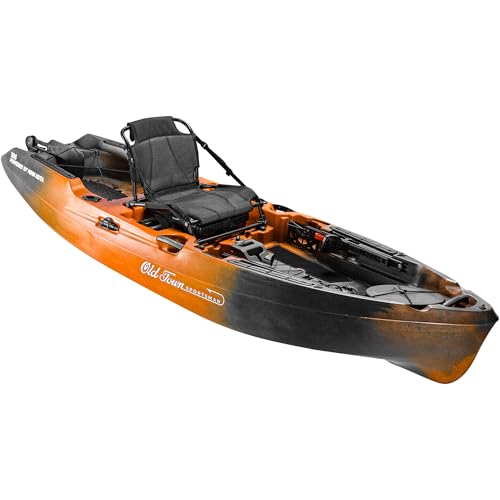
Old Town Sportsman 106 powered by Minn Kota
$2,699.99A factory integrated Minn Kota with the battery and wiring already solved, which is genuinely different to bolting a motor onto a paddle kayak.
Best for: Anyone who wants a motorised kayak without engineering the install
Check price on Amazon
Wilderness Systems Recon 120 sit-on-top fishing kayak
$1,619.00 Published specsA premium frame seat and a hull designed around standing, from the maker most serious paddle anglers end up with.
Check price on Amazon
Pelican Catch 110HDII pedal fishing kayak
$1,386.74The HyDryve pedal system and an ergonomic seat at roughly half what the established pedal kayaks cost.
Check price on AmazonEvery figure shown is the manufacturer own published specification. The rating on the unit you receive is what governs, and the capacity plate on your own boat governs everything above it.
What a rigged fishing load actually weighs
A basic rigged load runs somewhere around 45 to 60 lb before a battery and a motor, and a motor plus a lithium pack adds roughly 50 lb more.
Rule of thumb Boating and fishing convention rather than a published standard. Taught everywhere, useful, and not a specification. Nothing enforces it and no body publishes it.
| Item | Typical weight | Notes |
|---|---|---|
| Life jacket, worn | 1 to 2 lb | Worn rather than carried, and not optional |
| Paddle | 2 to 3 lb | Carbon shaft at the light end, aluminium at the heavy |
| Crate with tackle and three rods | 20 to 30 lb | The largest variable item on most kayaks |
| Fish finder, mount and arm | 3 to 6 lb | Before the battery |
| Sealed lead acid battery, 9 Ah | 5 to 7 lb | The usual kayak sonar battery |
| 12 V 100 Ah lithium pack | 25 to 30 lb | Only if you are running a trolling motor |
| Trolling motor with a short shaft | 20 to 30 lb | Plus the mount |
| Anchor, trolley and rode | 5 to 10 lb | A small grapnel or a stake out pole |
| Water, food and dry bag | 8 to 15 lb | Heavier than people estimate on a full day |
| Shallow water anchor with its own battery | 15 to 25 lb | A real weight on a kayak |
These are typical ranges from published product weights rather than measurements of any particular kit. Weigh your own load if the answer comes out close.
Why loading to the stated maximum is a bad idea
A hull at its stated maximum sits deep, and three things happen at once. It loses freeboard, so a modest wake comes over the side. It gets slower and harder to paddle, because more hull is wetted. And it gets less stable, because the centre of gravity has risen relative to the waterline.
All three arrive together, and they arrive fastest on a short wide fishing hull, which is the kind most people buy. Loading to seventy percent is not caution, it is what makes the boat behave the way the reviews described.
Adding a motor changes everything
A trolling motor and a lithium battery together run somewhere around 50 lb, which on most fishing kayaks is the majority of the remaining capacity after an adult paddler and a rigged crate. That is the whole reason factory motorised kayaks exist as a separate product: they are built around the weight from the start rather than having it added.
If the answer below is tight and you want a motor, the honest options are a lighter battery, a bigger hull, or a pedal drive instead of an electric one.
Frequently asked questions
How much can a kayak actually carry?
About seventy percent of its stated maximum in practice, so a 400 lb rated hull carries roughly 280 lb comfortably. The stated figure is the load at which the hull still floats rather than the load at which it still paddles. At the maximum the boat sits deep, loses freeboard, gets slower and becomes noticeably less stable, and all three arrive together.
Do kayaks have a Coast Guard capacity plate?
No, and this is widely misunderstood. The federal capacity plate requirement covers monohull boats under twenty feet that are propelled by machinery. Canoes and kayaks are not covered, so a kayak stated capacity is entirely the manufacturer own figure, and makers do not all measure or define it the same way. There is no standard behind the number.
Is seventy percent a real rule?
It is paddling convention rather than a published standard, and the range in common use runs from sixty to seventy five percent. Seventy is the usual planning figure. Sixty is the figure people drop to for chop, current or cold water, because freeboard is the margin that matters when water is coming at the boat rather than sitting under it.
Can I fit a trolling motor to my fishing kayak?
The weight decides. A motor and a lithium battery together run around 50 lb, which on most hulls is the majority of what is left after an adult and a rigged crate. Run the numbers before buying. If it is tight, a lighter battery, a bigger hull or a pedal drive are the honest alternatives to loading past the practical figure.
Does a pedal drive count against my capacity?
It is already in the boat. A pedal drive is part of the kayak as sold, so its weight sits in the hull weight rather than the payload, though it is the reason pedal kayaks are heavy to car top. What counts against your payload is anything you add: a motor, a battery, a crate and every rod that goes in it.
How much freeboard should I have?
There is no published minimum for a kayak and we do not invent one. Freeboard depends entirely on hull shape. The only honest test is to load the boat the way you intend to fish it, float it somewhere shallow and sheltered, and watch how much hull is out of the water and how it behaves when a wake goes past.
Get the complete rigging shopping list
Every item in the beginner, intermediate and expert rigs for both a boat and a kayak, with running totals, in one printable list. No charge.
One list, no sequence of daily emails, and you can leave at any time.
Researched, not professional advice. This page is compiled from published engineering and regulatory figures, manufacturer specifications and owner-review consensus, not hands-on testing. Figures described as a rule of thumb are boating convention rather than published standards, and they are labelled that way wherever they appear. Marine electrical work is not house wiring. Use tinned, finely stranded marine cable, size it for voltage drop and for the ABYC E-11 ampacity table rather than one or the other, and put overcurrent protection within seven inches of the battery positive terminal, because everything between the post and the fuse is unprotected. A lithium battery needs a charger with a lithium profile. Never load a boat past its capacity plate, and remember that canoes and kayaks carry no federal capacity plate at all, so their stated capacity is the manufacturer own figure. Wear the life jacket, and treat early season water as the hazard it is: cold water immersion takes your breath and then your hands long before it takes your core.