Batteries and run time
Lithium against lead acid, at your own draw
Quick answer
At a 42 amp draw, a 100 Ah AGM battery gives about 1.8 hours and a 100 Ah LiFePO4 pack about 3.9 hours, roughly 2.1 times as long from the same nameplate. The gap comes from two separate effects that multiply rather than add.
Two 100 Ah batteries are not the same purchase, and the size of the difference depends on how hard you work them. At a gentle draw the gap narrows. At trolling motor currents it is large.
The two effects are separate and they multiply. Peukert: LiFePO4 delivers essentially its rated capacity at any draw, where AGM gives up a real fraction at high current. Depth of discharge: lithium is planned to eighty percent, lead acid conventionally to fifty. Enter your own draw and the calculator shows both, separately, so you can see which one is doing the work.
Compare at your own draw
At 42 amps, lithium gives about 2.1 times the run time of the same nameplate in AGM.
| Figure | Value |
|---|---|
| AGM delivered at this draw | 73 Ah |
| AGM usable to 50 percent | 36 Ah |
| AGM run time | 0.9 h |
| LiFePO4 delivered at this draw | 96 Ah |
| LiFePO4 usable to 80 percent | 77 Ah |
| LiFePO4 run time | 1.8 h |
| Lithium advantage | 2.1 times as long |
Shown with the example figures above. Change any field to run your own numbers.
The working
Published figurefor each chemistry: Peukert t = 20 x ( C / ( I x 20 ) ) ^ k usable run time = t x depth of discharge AGM k = 1.15 depth of discharge = 0.50 LiFePO4 k = 1.02 depth of discharge = 0.80
Peukert equation is published battery engineering. The depth of discharge multipliers are convention on lead acid and manufacturer guidance on lithium. A published engineering, regulatory or manufacturer figure. It does not change because somebody disagrees with it.
Both chemistries, and the charger the lithium one needs
A lithium pack is only half the purchase. If your existing charger has no lithium profile, the charger is part of the cost of switching and not an optional extra.

LiTime 12V 100Ah Group 24 LiFePO4 battery
$365.99 Published specsGroup 24 case, which matters because it drops into an existing battery tray without rebuilding the compartment.
Check price on Amazon
LiTime 12V 100Ah trolling motor LiFePO4 battery for marine and yacht
$355.99 Published specsThe same capacity in the marine housing, and the usual alternative listing when the other is out of stock.
Check price on Amazon
LiTime 12V 100Ah Xtra Mini LiFePO4 battery
$338.39 Published specsA physically smaller 100 Ah pack, which is the whole argument for lithium on a kayak where the compartment is the constraint.
Best for: Kayaks and small boats where the battery box space is fixed
Check price on Amazon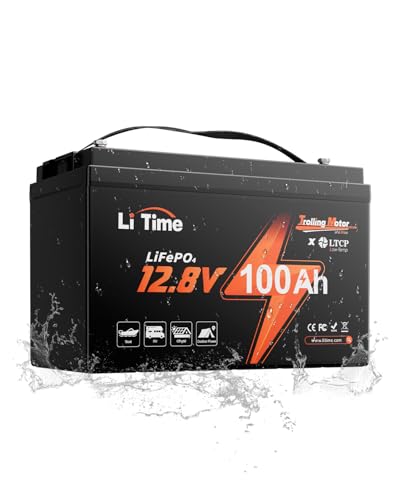
LiTime 12V 100Ah trolling motor LiFePO4 battery
$335.99 Published specsBuilt for the trolling motor case specifically, which mainly means a BMS sized to sustain the high continuous discharge a motor asks for.
Best for: A 55 lb thrust 12 volt motor on a boat that fishes full days
Check price on Amazon
LiTime 12V 100Ah Group 27 LiFePO4 battery
$320.39 Published specsThe Group 27 case for boats whose trays were built around lead acid of that size.
Check price on Amazon
VMAX XTR27-110 12V 110Ah AGM Group 27 battery
$299.96 Published specsThe high performance VMAX line, built for deeper and more frequent cycling than the standard MR series.
Check price on AmazonEvery figure shown is the manufacturer own published specification. The rating on the unit you receive is what governs, and the capacity plate on your own boat governs everything above it.
Where the difference comes from
Lithium wins twice over, and the effects multiply rather than add, which is why the same nameplate roughly doubles rather than improving by a third.
Published figure A published engineering, regulatory or manufacturer figure. It does not change because somebody disagrees with it.
| Effect | AGM | LiFePO4 | Kind of figure |
|---|---|---|---|
| Peukert exponent | 1.15 | 1.02 | Published battery engineering |
| Capacity delivered at a heavy draw | Noticeably below rating | Close to rating | Follows from the exponent |
| Depth of discharge planned | 50 percent | 80 percent | Convention on lead acid, maker guidance on lithium |
| Weight for the same nameplate | Roughly three times the lithium | The lightest option here | A per product manufacturer figure |
| Typical price for the same nameplate | Roughly a third of the lithium | The most expensive option here | Market, not a specification |
| Charge acceptance | Ceiling around a quarter of capacity | Up to about half of capacity | Maker guidance |
Peukert exponents and the twenty hour rating basis are published. The fifty percent lead acid depth of discharge guideline is convention and no standards body publishes it. Weight is a specification for each individual battery rather than a general rule, so no figure is given here.
When lithium is not worth it
This is the part most comparisons leave out. If you already finish a normal day with plenty left in an AGM, lithium buys you nothing you use. The extra capacity is a margin you never touch, and a 100 Ah AGM at a third of the price is the better purchase.
Lithium earns its money in three specific situations: when you genuinely run out of battery before you run out of day, when weight is the binding constraint, which on a kayak or a small boat it usually is, and when you need the boat back out the next morning, because lithium recharges in a fraction of the time and does not have lead acid slow final absorption stage.
The cost that gets forgotten
A lithium pack needs a charger with a lithium profile, and if your onboard charger does not have one, that is part of the price of switching. A lead acid profile either never reaches the bulk voltage the pack needs, so it sits permanently part charged, or holds it at a float voltage it should not sit at.
Neither failure announces itself. The pack simply underperforms or ages badly, and people blame the battery. Chargers that carry a lithium profile state it in the specification, and on a mixed boat where the motor bank is lithium and the cranking battery is still lead acid you need one that sets its profile per bank.
Frequently asked questions
Is a 100 Ah lithium battery really worth three 100 Ah lead acid ones?
Not three, but roughly two at a trolling motor draw. At 42 amps a 100 Ah AGM gives about 1.8 hours and a 100 Ah LiFePO4 about 3.9 hours, because lithium delivers close to its rating at any draw and is planned to eighty percent rather than fifty. Whether that is worth the money depends entirely on whether you currently run out.
Why does the advantage depend on my draw?
Because the Peukert half of the advantage only appears under load. At a gentle draw an AGM delivers close to its rating too, so the only difference left is depth of discharge, which is a fixed factor of about 1.6. At a heavy draw the AGM also gives up capacity to Peukert, and the two effects multiply into roughly double.
Can I use my existing charger with a lithium battery?
Only if it has a lithium profile, and this is not optional. A lead acid profile either never reaches the bulk voltage a LiFePO4 pack needs, leaving it permanently part charged, or holds it at a float voltage it should not sit at. Neither failure is obvious until damage is done. Chargers with a lithium profile say so in their specification.
How much weight does lithium actually save?
Roughly two thirds for the same nameplate, but the exact figure is a specification for each individual battery rather than a general rule, so we do not publish a pounds per amp hour number. On a three battery 36 volt boat the saving is large enough to change how the hull sits, and on a kayak it is frequently the whole reason to switch.
Does lithium work in cold weather?
It holds capacity better than lead acid in the cold, which helps early season. The catch is charging: LiFePO4 must not be charged below freezing without a battery management board that handles it, which is why low temperature protection appears in the specifications of the better packs. Discharging in the cold is generally fine.
What about the cost per cycle argument?
We do not publish one, deliberately. LiFePO4 cycle life claims range from 4,000 to 15,000 depending on the seller and the depth of discharge the count assumes, and lead acid cycle life varies enormously with how it is used. Multiplying an unverifiable cycle count by a moving price produces a confident figure built on two guesses.
Get the complete rigging shopping list
Every item in the beginner, intermediate and expert rigs for both a boat and a kayak, with running totals, in one printable list. No charge.
One list, no sequence of daily emails, and you can leave at any time.
Researched, not professional advice. This page is compiled from published engineering and regulatory figures, manufacturer specifications and owner-review consensus, not hands-on testing. Figures described as a rule of thumb are boating convention rather than published standards, and they are labelled that way wherever they appear. Marine electrical work is not house wiring. Use tinned, finely stranded marine cable, size it for voltage drop and for the ABYC E-11 ampacity table rather than one or the other, and put overcurrent protection within seven inches of the battery positive terminal, because everything between the post and the fuse is unprotected. A lithium battery needs a charger with a lithium profile. Never load a boat past its capacity plate, and remember that canoes and kayaks carry no federal capacity plate at all, so their stated capacity is the manufacturer own figure. Wear the life jacket, and treat early season water as the hazard it is: cold water immersion takes your breath and then your hands long before it takes your core.