VHF radios
Which marine VHF radio should you buy?
Quick answer
A phone is not a marine radio. Channel 16 on a VHF like the Uniden UM385 reaches every boat in range and the Coast Guard at once, and a DSC distress button sends a position with one press, but only if the radio has built-in GPS, like the Uniden UM725G, or is wired to an external GPS source.
A cell phone works until it does not: out of signal range, dropped overboard, or simply unable to reach anyone else on the water at the same time. Marine VHF is built for exactly the opposite case. Channel 16 is the hailing and distress frequency every VHF radio monitors, so a call on channel 16 reaches every other boat within range and the Coast Guard simultaneously, something no phone call to a single number can do.
Digital Selective Calling, or DSC, is the feature that turns a distress call into more than a voice broadcast. Pressing the dedicated distress button on a DSC equipped radio sends a digital alert on channel 70 along with the boat's registered identity, and if the radio has a GPS position, that position rides along with the alert automatically. A DSC radio with no GPS fix, either built in or fed from an external antenna, still sends the distress alert, just without a position attached, which is a meaningfully weaker version of the same feature.
This roundup covers both handheld and fixed mount radios, since the right choice depends heavily on whether a boat has 12 volt wiring and a masthead antenna to take advantage of, or needs a radio that works the same on a kayak with no wiring at all.
On this page
How this list was put together
This roundup is based on published manufacturer specifications and verified owner reviews, compared side by side. The wattage, DSC class and waterproof ratings below each come from the manufacturer's own listing, not a claim made for this page.
Marine VHF radios by power, mount and DSC
Wattage, mount type and DSC capability are each a published spec on the radio itself.
A fixed mount radio like the Uniden UM725G fixed mount marine VHF with GPS runs up to 25 watts against 6 watts on the best handhelds here, and only the UM725G in this table has both DSC and built-in GPS together.
Published figure A published engineering, regulatory or manufacturer figure. It does not change because somebody disagrees with it.
| Radio | Mount | Watts | DSC / GPS | Price |
|---|---|---|---|---|
| Uniden Atlantis 155 handheld VHF, floating and submersible | Handheld | 6 | No / No | $67.99 |
| Standard Horizon HX210 6W floating handheld VHF | Handheld | 6 | No / No | $114.25 |
| Icom M25EVO floating marine VHF radio | Handheld | Not published | No / No | $161.90 |
| Uniden UM385 25W fixed mount marine VHF with DSC | Fixed | 25 | Yes / No | $107.99 |
| Standard Horizon GX1410 Eclipse 25W fixed mount VHF | Fixed | 25 | Yes / No | $138.15 |
| Uniden UM725G fixed mount marine VHF with GPS | Fixed | 25 | Yes / Yes | $158.75 |
Best marine VHF for a kayak or small boat
A handheld with no wiring required is the only realistic choice on a kayak, and a floating, waterproof one removes the single biggest handheld failure mode: dropping it overboard.

Uniden Atlantis 155 handheld VHF, floating and submersible
$67.99IPX8 submersible rating and a floating body under seventy dollars, which is the cheapest defensible handheld in this roundup.
Best for: A kayak or small skiff with no fixed radio installed
Check price on AmazonBest marine VHF for a boat with 12 volt wiring
Twenty five watts into a masthead antenna reaches dramatically farther than any handheld, and adding DSC is the meaningful safety upgrade over a handheld-only setup.
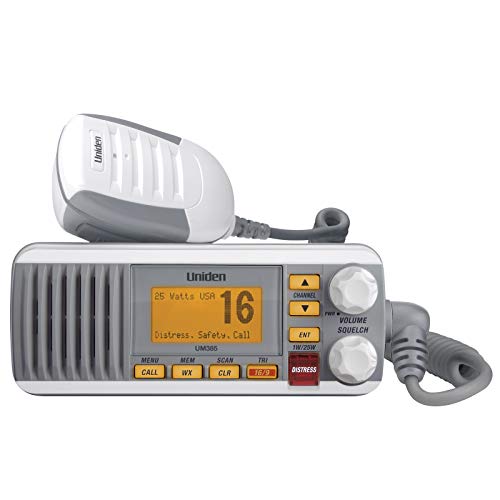
Uniden UM385 25W fixed mount marine VHF with DSC
$107.99 Published specsClass D DSC with a dedicated distress button, waterproof to IPX4, at close to the price of a decent handheld alone.
Best for: The first fixed radio on a boat that goes out of sight of the ramp
Check price on AmazonBest marine VHF for a working distress button
DSC without a GPS fix still sends a distress alert, just without a position attached. Built-in GPS closes that gap without wiring a separate antenna.

Uniden UM725G fixed mount marine VHF with GPS
$158.75 Published specsBuilt-in GPS feeds the DSC distress call a real position automatically, and IPX8 submersible rating covers the radio itself against spray and rain.
Best for: Anyone who wants a DSC distress call to send a position without wiring the radio to a separate chartplotter or GPS antenna
Check price on AmazonWho should not buy this tier: A kayak or any small boat with no permanent 12 volt wiring to run a fixed set. A floating handheld like the Uniden Atlantis 155 or Standard Horizon HX210 is the only sensible choice there, since a fixed radio needs a mount, an antenna and a wired power source none of those hulls provide.
Handheld or fixed mount, which comes first?
A fixed mount radio wins on raw range because it runs full legal power into a taller, better positioned antenna: 25 watts on units like the Standard Horizon GX1410 against 6 watts on the best handhelds here, such as the Standard Horizon HX210. A handheld wins on flexibility, since it needs no wiring, works the same on a kayak or a dinghy, and floats if it goes over the side, which several units in this roundup are specifically built to do. A boat with the wiring for a fixed set generally benefits from both: a fixed radio for daily use and range, with a floating handheld as backup if the boat is abandoned or a crew member goes over the side without it.
How we chose
We did not test this equipment in person and we never claim to. Picks are researched from manufacturer specification sheets, published engineering and regulatory figures, and the recurring themes in verified owner reviews. Every pick is matched to a real thrust rating, a real published amp draw, a real capacity or a real conductor size rather than to a price bracket, and it is placed in the tier where its published capability actually belongs. We rejected the unbranded flood that dominates several of these search results, because a lithium pack whose management board is the only thing between a cell fault and a fire, a breaker protecting a battery cable, a life jacket and a bracket holding a two thousand dollar motor to the bow at highway speed are all parts whose failure has a consequence nobody can walk away from. Where a figure is convention rather than a published standard we label it that way, and where a manufacturer does not publish a figure we leave it out instead of estimating it.
Sources
- Standard Horizon published specifications for the HX210 and GX1410 Eclipse
- Uniden published specifications for the Atlantis 155, Atlantis 275, UM385 and UM725G
- ICOM published specifications for the M25EVO and IC-M330
Frequently asked questions
Why is a marine VHF radio better than a phone on the water?
A phone call reaches one number and depends on cell coverage, which drops off well before most boats are out of sight of land. A VHF call on channel 16 reaches every other boat within range and the Coast Guard at the same time, with no cell tower required, and a DSC equipped radio adds a one button distress alert a phone cannot replicate.
What does DSC actually do on a marine VHF radio?
Digital Selective Calling sends a digital distress alert on channel 70 with the boat identity attached, triggered by a dedicated button rather than a spoken call. If the radio has a GPS fix, either built in like the Uniden UM725G fixed mount marine VHF with GPS or fed from an external antenna, that position rides along with the alert automatically, which is the feature that makes a rescue response faster.
Does a handheld VHF need a GPS to send a useful distress call?
None of the handhelds in this roundup include DSC or GPS, so a distress call from one relies on voice communication on channel 16 rather than a digital position alert. That still reaches every listening boat and the Coast Guard, it just requires speaking a location rather than transmitting one automatically, which is the tradeoff for a radio with no wiring required.
Is 25 watts always better than 6 watts on a marine VHF?
Range depends on antenna height as much as power, since VHF signals travel mostly line of sight. A 25 watt fixed radio like the Uniden UM385 25W fixed mount marine VHF with DSC into a masthead antenna reaches farther than any handheld because of that antenna height, not power alone. A 6 watt handheld like the Standard Horizon HX210 6W floating handheld VHF still covers a meaningful range and wins on flexibility since it needs no wiring at all.
Should a boat with a fixed VHF radio also carry a handheld?
Yes, as a backup. A fixed radio depends on the boat 12 volt power and its wired antenna, both of which are unavailable if the boat is abandoned or someone goes over the side. A floating handheld such as the Uniden Atlantis 155 handheld VHF, floating and submersible works independently of the boat electrical system and is built to survive being dropped in the water.
What waterproof rating should a marine VHF radio have?
IPX7 or higher for a handheld that might get splashed or dropped, and IPX8 for genuine submersible protection, which several handhelds in this roundup carry along with a floating body. A fixed mount radio inside a console has less exposure but still benefits from a waterproof rating like the IPX4 on the Uniden UM385 25W fixed mount marine VHF with DSC for spray and rain.
Get the complete rigging shopping list
Every item in the beginner, intermediate and expert rigs for both a boat and a kayak, with running totals, in one printable list. No charge.
One list, no sequence of daily emails, and you can leave at any time.
Researched, not professional advice. This page is compiled from published engineering and regulatory figures, manufacturer specifications and owner-review consensus, not hands-on testing. Figures described as a rule of thumb are boating convention rather than published standards, and they are labelled that way wherever they appear. Marine electrical work is not house wiring. Use tinned, finely stranded marine cable, size it for voltage drop and for the ABYC E-11 ampacity table rather than one or the other, and put overcurrent protection within seven inches of the battery positive terminal, because everything between the post and the fuse is unprotected. A lithium battery needs a charger with a lithium profile. Never load a boat past its capacity plate, and remember that canoes and kayaks carry no federal capacity plate at all, so their stated capacity is the manufacturer own figure. Wear the life jacket, and treat early season water as the hazard it is: cold water immersion takes your breath and then your hands long before it takes your core.