Safety
Handheld or fixed mount VHF: does your boat need both?
Quick answer
A fixed mount VHF running 25 watts into a masthead antenna reaches far past any 6 watt handheld, and it is the primary radio for any boat leaving sight of the ramp. A handheld is the backup, the kayak radio, or the only radio on a boat too small for a fixed antenna, and a phone is not a substitute for either one.
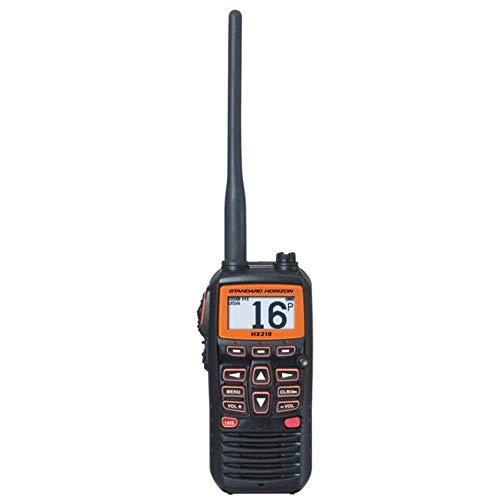
Standard Horizon HX210 6W floating handheld VHF
$114.25Six watts, the full legal handheld power, floats, and needs no installation beyond charging it
Best for: A kayak or a small boat with no fixed radio
Check price on Amazon
Standard Horizon GX1410 Eclipse 25W fixed mount VHF
$138.15Twenty five watts into a masthead antenna, with Class D DSC and a compact case for a small console
Best for: The first fixed radio on a boat that goes out of sight of the ramp
Check price on AmazonA phone is not a marine radio, no matter how good the cell signal is at the dock. Channel 16 reaches every boat within range and the Coast Guard at once, on a network built for exactly that purpose, while a phone call reaches one person, needs a number you may not have, and drops the moment you are past cell coverage, which on open water is closer than most boaters expect. Neither a handheld nor a fixed mount VHF has that problem, and the real decision between the two is range, not whether you need one at all.
A fixed mount set pushes a published 25 watts into an antenna mounted as high on the boat as the mast or arch allows, and VHF range comes largely from antenna height above the water rather than wattage alone, which is why a fixed set reaches so much further than a 6 watt handheld held at arm's length in the cockpit. Neither maker publishes an exact range figure for either radio, because that range depends on antenna height and the horizon distance it creates rather than on watts by themselves, so treat any specific mileage claim you see elsewhere with some skepticism.
Digital Selective Calling adds a third factor worth understanding before buying either type: a DSC distress button sends your position automatically with one press only if the radio itself has GPS built in or is fed a position from an external GPS antenna. A radio with DSC but no GPS input still sends a distress call, just without the position attached.
On this page
Why a phone cannot do either radio job
A distress call on Channel 16 is heard by every vessel and the Coast Guard within radio range simultaneously, which is exactly the kind of broadcast a phone call cannot replicate since a phone call reaches one number at a time. Cell coverage also thins out or disappears entirely well within sight of shore on many bodies of water, long before a VHF signal would, and a dead phone battery or a phone that went in the water ends the conversation instantly with no backup. A VHF radio, handheld or fixed, is built for exactly the emergency a phone is the wrong tool for.
Power and range, and why range is not a single published number
The fixed GX1410 transmits at a published 25 watts against 6 watts for the handheld HX210, but real world range depends on antenna height as much as wattage, so neither maker publishes a fixed mileage figure for either radio.
Published figure A published engineering, regulatory or manufacturer figure. It does not change because somebody disagrees with it.
| Radio | Mount | Published watts | DSC |
|---|---|---|---|
| Standard Horizon HX210 | Handheld | 6 W | No |
| Standard Horizon GX1410 | Fixed | 25 W | Class D |
| Uniden UM725G | Fixed | 25 W | Class D, with built in GPS |
Range is not published as a single mileage figure by either maker because it depends on antenna height and the resulting radio horizon, which a masthead mounted fixed antenna extends far past a handheld held at cockpit height.
DSC sends a position with one press, only if it has GPS
A Digital Selective Calling distress button transmits a distress alert with a single press on any DSC equipped radio, but it only attaches your actual position to that alert if the radio has a GPS receiver of its own or is receiving position data from an external one. The Uniden UM725G solves this by building GPS directly into the radio. The GX1410 supports Class D DSC but needs a position fed to it, which a NMEA 2000 GPS antenna such as the Garmin GPS 24xd provides over the boat's existing network. A DSC radio with neither its own GPS nor a fed position still sends a distress alert, it simply arrives without a location attached, which matters considerably to whoever is trying to find you.
When a handheld is the right, and only, radio
A floating 6 watt handheld is the right primary radio for a kayak, a small skiff with no mast or arch to mount an antenna on, or anyone who wants a radio that comes out of the boat, into a truck, or onto a paddleboard without any installation at all. It is also the sensible backup radio on a larger boat with a fixed set already installed, kept charged and ready in case the fixed set or its antenna cable fails at the wrong moment.
When a fixed mount set is worth installing
Any boat that regularly leaves sight of the ramp benefits from a fixed mount set's greater range, powered directly off the boat's own battery rather than a handheld's limited internal charge, and left permanently wired and ready rather than something to remember to grab and charge. The GX1410's compact case fits a console with limited space, which removes the usual excuse for skipping a fixed set on a smaller boat.
Which one should you actually buy
Buy a handheld like the HX210 first if the boat is a kayak or small craft with nowhere to mount a fixed antenna, or as a backup radio alongside a fixed set on anything larger. Buy a fixed set like the GX1410 for any boat that regularly runs out of sight of the ramp, and add a GPS feed, either built in as on the UM725G or fed from an antenna like the Garmin GPS 24xd, so a DSC distress call actually carries your position along with it.
Frequently asked questions
Can a handheld VHF fully replace a fixed mount radio on a boat with a console?
Not for range. A handheld's antenna sits at cockpit height and its transmit power tops out at 6 watts, both of which limit range compared to a fixed set pushing 25 watts into a masthead antenna. A handheld works fine as the only radio on a small boat with nowhere to mount a fixed antenna, but it is a real downgrade in reach on any boat that could carry a fixed set instead.
Does my DSC radio need its own GPS, or can it share one with my chartplotter?
Either works. A radio with built in GPS, like the Uniden UM725G, needs nothing else connected. A radio without one, like most compact fixed mount sets, can receive position data from an external GPS antenna or from a chartplotter already on the boat's NMEA 2000 network, as long as that connection is actually wired and configured correctly.
What happens if I press the DSC distress button with no GPS connected?
The radio still transmits a distress alert with your MMSI to every DSC equipped station in range and to the Coast Guard, it simply does not include your position in that alert. Responders then have to rely on other methods to locate you, which takes longer and is considerably less reliable than a position sent automatically with the call.
Is a floating handheld radio actually necessary, or is that just a nice feature?
It matters more than it sounds. A handheld dropped overboard during the exact kind of emergency that made you grab it in the first place is useless if it sinks. A floating model like the HX210 stays on the surface and is easier to retrieve, which is a real, practical safety feature rather than a marketing detail.
Can I use a marine VHF radio for anything other than emergencies?
Yes, routine ship to ship communication, hailing a marina, checking weather channels and coordinating with other boats in your group are all normal, legal uses of a VHF radio outside of Channel 16, which is reserved for hailing and distress. Most radios also receive NOAA weather channels and alerts continuously in the background.
Do I need both a handheld and a fixed mount radio on the same boat?
For any boat that leaves sight of the ramp regularly, yes, a fixed set as the primary radio for range and a handheld as backup or for anyone leaving the boat in a dinghy or kayak covers both jobs a single radio cannot. A small boat with no fixed antenna mount reasonably runs on a handheld alone instead.
Get the complete rigging shopping list
Every item in the beginner, intermediate and expert rigs for both a boat and a kayak, with running totals, in one printable list. No charge.
One list, no sequence of daily emails, and you can leave at any time.
Researched, not professional advice. This page is compiled from published engineering and regulatory figures, manufacturer specifications and owner-review consensus, not hands-on testing. Figures described as a rule of thumb are boating convention rather than published standards, and they are labelled that way wherever they appear. Marine electrical work is not house wiring. Use tinned, finely stranded marine cable, size it for voltage drop and for the ABYC E-11 ampacity table rather than one or the other, and put overcurrent protection within seven inches of the battery positive terminal, because everything between the post and the fuse is unprotected. A lithium battery needs a charger with a lithium profile. Never load a boat past its capacity plate, and remember that canoes and kayaks carry no federal capacity plate at all, so their stated capacity is the manufacturer own figure. Wear the life jacket, and treat early season water as the hazard it is: cold water immersion takes your breath and then your hands long before it takes your core.