Trolling Motors
Which trolling motor should you put on a fishing kayak?
Quick answer
The Minn Kota Kayak Terrova 55 is the only Spot-Lock GPS bow motor built for a kayak bow, with a 36 inch shaft. Lighter budgets do better on a transom-mounted Newport motor with a 24 inch shaft and a portable battery.
A kayak trolling motor is not a boat motor with a shorter shaft bolted on, it is a genuinely different product built around two constraints a boat never has: total weight the hull can carry, and a battery that has to come off the kayak and back to the truck every single trip rather than living permanently under a console. Get either one wrong and the kayak either sits low and unstable in the water or becomes too heavy to load without a second person.
The mount matters as much as the motor here. A kayak transom mount motor typically runs a much shorter shaft than a kayak bow mount motor, because a scupper-mounted transom sits far closer to the water than a bow deck does, and the two are not interchangeable parts.
We compared published thrust, voltage and weight figures against each listing and read verified owner reviews for how these motors actually mount on real kayak hulls, rather than rigging every motor here to our own kayak.
On this page
Can your kayak handle a trolling motor and its battery?
Kayaks are not covered by the federal capacity plate requirement that applies to powered monohull boats under 20 feet, so a kayak's stated maximum capacity is the manufacturer's own figure rather than a Coast Guard rating, and different makers do not measure it the same way. A widely repeated planning figure loads a kayak to roughly 70 percent of its stated maximum rather than the full number, which leaves the hull tracking and paddling normally instead of merely floating. A motor plus its battery can easily add 30 to 60 lb, so weigh paddler, gear, motor and battery together against 70 percent of the rated capacity before buying. Run your own numbers on the kayak weight capacity calculator.
Bow mount or transom mount on a kayak?
A kayak bow motor mounts up front like a small boat bow motor and typically needs a longer shaft, around 36 inches, because the bow sits higher above the water than a scupper does. A kayak transom mount motor clamps to an aftermarket bracket at the back, sitting much closer to the waterline, and usually runs a shorter 24 inch shaft. Neither shaft length is interchangeable with the other mount position on the same kayak.
A kayak bow sitting 12 inches above the waterline needs at least a 30 inch shaft in sheltered water, and 36 inches in chop.
Rule of thumb Boating and fishing convention rather than a published standard. Taught everywhere, useful, and not a specification. Nothing enforces it and no body publishes it.
| Bow height above waterline | Shaft needed, sheltered water | Shaft needed, rough water |
|---|---|---|
| 6 in | 30 in | 30 in |
| 10 in | 30 in | 30 in |
| 12 in | 30 in | 36 in |
A scupper-mounted transom sits much closer to the waterline than a kayak bow, which is why transom kayak motors commonly run a shorter 24 inch shaft instead.
Thrust and voltage stay small on a kayak
Almost every kayak trolling motor stays at 12 volts, because a kayak rarely weighs enough loaded to justify the extra battery a 24 volt system requires, and a second battery is exactly the weight and space a kayak has the least of. The two to five pounds of thrust per hundred pounds convention still applies, just against a much smaller loaded weight than a boat.
A 12 volt motor rated between 36 and 55 lb of thrust draws up to 42 to 50 amps at full power, the same figures published for small boat transom motors.
Published figure A published engineering, regulatory or manufacturer figure. It does not change because somebody disagrees with it.
| Thrust (lb) | System voltage | Batteries | Published max draw |
|---|---|---|---|
| 40 | 12V | 1 | 42A |
| 45 | 12V | 1 | 42A |
| 55 | 12V | 1 | 50A |
Always check the figure printed on your own motor. A dedicated kayak motor and a small boat transom motor of the same thrust rating are not always identical products.
Beginner: the lightest working setup
Weight is the binding constraint on a kayak, so a first motor should be the smallest one that genuinely moves the boat rather than the largest one that fits the budget.
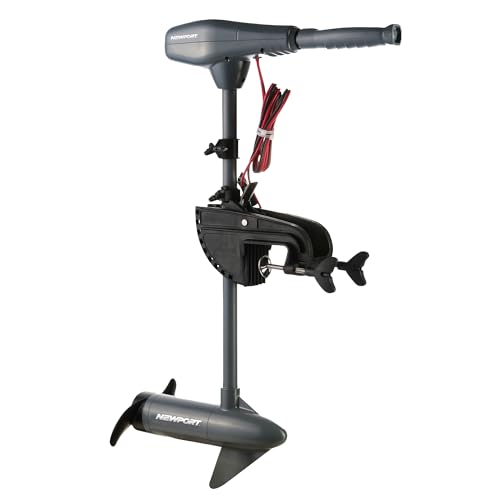
Newport Kayak Series 36 lb thrust, 24 inch shaft
$169.99 Published specsA 24 inch fiberglass shaft, the length a kayak transom actually needs rather than a full length boat shaft that looks wrong on one.
Best for: Kayaks and small inflatables where a 30 inch shaft is too long
Check price on Amazon
Newport kayak transom motor mount
$119.99Kayaks mostly do not have a transom, and this bracket gives them one to clamp a motor onto.
Check price on AmazonIntermediate: more thrust for tidal water
Considerably more thrust than a kayak needs on flat water is exactly the point on a tidal river or a lake that turns choppy in the afternoon.
Newport Kayak Series 55 lb thrust, 24 inch shaft
$239.99 Published specsConsiderably more thrust than a kayak needs in calm water, which is exactly the point on a tidal river.
Check price on AmazonExpert: a real bow motor built for a kayak bow
A proper GPS bow motor built for a kayak bow is a different category from a repurposed transom motor, and the price reflects it.

Minn Kota Kayak Terrova 55 with GPS, 36 inch shaft
$1,261.26 Published specsA proper Spot-Lock bow motor built for a kayak bow and a 36 inch shaft, a genuinely different product to a cut down boat motor.
Best for: A pedal or paddle kayak being converted to a power fishing platform
Check price on AmazonWho should not buy this tier: Anyone who mainly wants push power to reposition between casts. A Spot-Lock kayak bow motor costs several times what a basic transom motor does, and that premium buys GPS anchoring a paddler simply may not need.
How we chose these kayak motors
We compared published thrust, voltage and shaft length against each listing and weighed motor plus battery against typical kayak rated capacities using the manufacturer's own figures. This is research and specification comparison, based on published specifications and verified owner reviews, not a rigged and paddled trial of every motor here.
How we chose
We did not test this equipment in person and we never claim to. Picks are researched from manufacturer specification sheets, published engineering and regulatory figures, and the recurring themes in verified owner reviews. Every pick is matched to a real thrust rating, a real published amp draw, a real capacity or a real conductor size rather than to a price bracket, and it is placed in the tier where its published capability actually belongs. We rejected the unbranded flood that dominates several of these search results, because a lithium pack whose management board is the only thing between a cell fault and a fire, a breaker protecting a battery cable, a life jacket and a bracket holding a two thousand dollar motor to the bow at highway speed are all parts whose failure has a consequence nobody can walk away from. Where a figure is convention rather than a published standard we label it that way, and where a manufacturer does not publish a figure we leave it out instead of estimating it.
Frequently asked questions
Does a kayak have a Coast Guard capacity plate like a boat?
No. Federal capacity plate rules under 33 CFR 183 cover monohull boats under 20 feet that are propelled by machinery, and canoes and kayaks are explicitly not covered by that requirement. A kayak's stated maximum capacity is the manufacturer's own figure, not a federally regulated one, and different manufacturers do not always measure or define it the same way. Treat it as a useful reference point rather than a certified rating.
How much weight does a trolling motor and battery add to a kayak?
A small 12 volt kayak motor typically weighs 10 to 15 lb, and a single 12 volt deep cycle battery adds another 20 to 35 lb depending on chemistry and capacity, so budget 30 to 50 lb combined before adding the mount hardware. That is a meaningful chunk of most kayaks' rated capacity, which is why weighing the whole setup against 70 percent of the stated maximum matters more on a kayak than it does on a boat with far more capacity to spare.
Should I mount a kayak motor on the bow or the transom?
A bow mount gives straighter tracking and, on the Kayak Terrova, genuine GPS Spot-Lock anchoring, but needs a longer shaft and a bow rigged to accept a bracket. A transom mount is simpler to add to a kayak with no existing bow rigging, costs less, and uses a shorter shaft because a scupper sits closer to the waterline than a bow deck. Most anglers converting an existing paddle kayak start with a transom mount for exactly that reason.
Can I use a lithium battery on a kayak trolling motor?
Yes, and it is often the better choice on a kayak specifically because of weight: a lithium battery delivers close to its full rated capacity even at the higher currents a motor draws, where a lead acid battery of the same amp hour rating delivers noticeably less. The battery still needs a charger with a genuine lithium charge profile rather than a lead acid charger, since a lead acid profile will not fill a lithium pack correctly.
Why is the shaft on a kayak bow motor longer than on a kayak transom motor?
A kayak bow sits higher above the waterline than a scupper-mounted transom does on most hulls, so the same shaft length formula, measuring down to the water and adding 16 or 20 inches, produces a longer answer at the bow. That is why the dedicated Kayak Terrova bow motor runs a 36 inch shaft while Newport's kayak transom motors commonly run 24 inches, even though both are built for similar sized kayaks.
Is a Spot-Lock kayak bow motor worth the extra cost over a basic transom motor?
It depends on how you fish. GPS Spot-Lock anchoring holds position hands free over structure or a school of fish, which is genuinely valuable for anyone sight fishing or working a specific spot repeatedly. A paddler who mainly wants help covering distance between spots, without needing to hold a precise position, gets most of the practical benefit from a much cheaper transom motor without paying for GPS electronics that go unused.
Get the complete rigging shopping list
Every item in the beginner, intermediate and expert rigs for both a boat and a kayak, with running totals, in one printable list. No charge.
One list, no sequence of daily emails, and you can leave at any time.
Researched, not professional advice. This page is compiled from published engineering and regulatory figures, manufacturer specifications and owner-review consensus, not hands-on testing. Figures described as a rule of thumb are boating convention rather than published standards, and they are labelled that way wherever they appear. Marine electrical work is not house wiring. Use tinned, finely stranded marine cable, size it for voltage drop and for the ABYC E-11 ampacity table rather than one or the other, and put overcurrent protection within seven inches of the battery positive terminal, because everything between the post and the fuse is unprotected. A lithium battery needs a charger with a lithium profile. Never load a boat past its capacity plate, and remember that canoes and kayaks carry no federal capacity plate at all, so their stated capacity is the manufacturer own figure. Wear the life jacket, and treat early season water as the hazard it is: cold water immersion takes your breath and then your hands long before it takes your core.