Kayak fishing
Rigged pedal kayak or a jon boat: which one is actually the better buy?
Quick answer
A fully rigged pedal kayak costs roughly what a used aluminum jon boat with a small outboard does, and the boat is more capable in more conditions: it carries more, runs faster, and handles wind and chop the kayak cannot. The honest reason to choose the kayak is access to water no boat reaches, and quiet, not saving money.

Old Town Sportsman PDL 106 pedal fishing kayak
$2,699.99A reversible pedal drive, universal transducer mount and roughly 343 lb of usable capacity for people and gear
Best for: The pedal kayak most people should buy if the budget reaches
Check price on AmazonOnce a pedal kayak like the Sportsman PDL 106 is rigged with a battery, a fish finder and the accessories most anglers add, its total cost lands close to what a decent used 12 to 14 foot aluminum jon boat with a small outboard sells for on the used market. At that price parity the boat is honestly the more capable platform: it carries more weight, runs faster between spots, and handles wind and chop that would turn a kayak sideways or send water over the gunwale. Nobody should choose a rigged pedal kayak over a jon boat purely to save money, because at a comparable budget they usually do not.
The real case for the kayak is access. A pedal kayak floats and moves through skinny, choked, weed-covered water that no trailer boat, and often no jon boat, can reach at all, launches from a bank with no ramp in sight, and does it silently enough to fish spooky, shallow fish that hear an outboard or even a trolling motor from a distance. That is a genuinely different capability than the boat offers, not a cheaper version of the same one.
This catalog does not sell jon boats. It is a fishing electronics and boat rigging site built around sonar, trolling motors, batteries and kayak gear, not a boat dealer, so the jon boat side of this comparison is described honestly below without a product link pretending otherwise.
On this page
What a rigged pedal kayak actually costs, once you add the rest
The Sportsman PDL 106 itself lists at roughly $2,700. Add a fish finder, a mount, a battery to run it, and the paddle, cart and safety gear most anglers consider non-negotiable, and the total rigged cost climbs meaningfully past the hull price alone. That total lands in the same general neighborhood as a used aluminum jon boat with a small outboard on the used market, which is the comparison worth making honestly before assuming a kayak is automatically the budget option.
A rigged pedal kayak and a used aluminum jon boat with a small outboard land in the same general price range once sonar, a battery and rigging are added to the kayak side.
Rule of thumb Boating and fishing convention rather than a published standard. Taught everywhere, useful, and not a specification. Nothing enforces it and no body publishes it.
| Rigged pedal kayak | Used jon boat with small outboard | |
|---|---|---|
| Hull cost | $2,699.99 | Not sold in this catalog, varies by used market |
| Typical additions | Sonar, battery, mount, cart, safety gear | Registration, trailer, safety gear |
| General total range | Comparable once fully rigged | Comparable on the used market |
This is a general cost comparison based on published kayak pricing and typical used boat market ranges, not a specific published standard, since a jon boat is not a catalog item here to quote a fixed price for.
Where the boat is simply more capable
A jon boat with even a modest outboard covers water far faster than pedal power, runs comfortably in wind and light chop that would have a kayak angler working hard just to hold position, and carries multiple anglers, a cooler, and far more gear than the PDL 106's roughly 343 lb of usable capacity for people and gear allows. It can also run home ahead of building weather in a way a pedal kayak simply cannot. None of that is a close call, and pretending otherwise does a reader no favors.
Where the kayak wins: access, and quiet
A pedal kayak launches from a bank, a low bridge, a spot with no trailer access at all, and threads through skinny creeks, flooded timber and weed choked coves that ground out a boat's hull or foul its prop long before the kayak notices. It also does all of that in near silence, without the hull slap, the outboard idle, or the trolling motor hum that telegraphs a boat's approach to shallow, easily spooked fish well before it arrives. That access and that quiet are the genuine reason to choose a kayak, not a lower price tag once it is properly rigged.
A real buy path: rigging the kayak side of this comparison
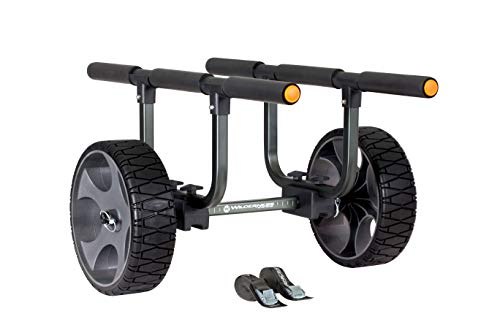
Wilderness Systems heavy duty kayak cart with flat-free wheels
$189.99Rated to 450 lb with flat-free wheels, built for moving a loaded pedal kayak alone
Best for: Moving a pedal kayak alone
Check price on Amazon
YakAttack BlackPak Pro 13 x 13 fishing crate with 3 rod holders
$129.95A rigid crate with three built in rod holders, the organized storage a pedal kayak needs that a boat gets from a console instead
Check price on AmazonWhich one should you actually buy
Buy the jon boat if raw capability, more capacity, more speed and handling more weather matters more to you than reaching water a boat cannot, and the used market has a decent hull available near you. Buy the pedal kayak if the water you actually want to fish is the skinny, choked, bank-launch kind a jon boat cannot reach, or if the quiet approach a paddle or pedal craft offers is worth more to your fishing than the boat's extra capability. Choose based on where you fish, not on which one you assume is cheaper, because rigged out they usually are not far apart.
Frequently asked questions
Is a pedal kayak really as expensive as a jon boat once it is rigged?
Once you add a fish finder, a battery to run it, a mount, a cart and basic safety gear on top of the hull price, a rigged pedal kayak's total cost commonly lands close to what a used aluminum jon boat with a small outboard sells for. It is not automatically the cheaper option, which is why access and quiet, not price, are the honest reasons to choose one.
Can a jon boat go anywhere a pedal kayak can?
No. A jon boat's hull, prop and draft keep it out of skinny, weed choked or flooded timber water that a pedal kayak floats through without trouble, and a jon boat generally needs some kind of bank or ramp access a kayak does not. That access gap, not price, is the real reason some anglers choose the kayak over a more capable boat.
Why does not this site sell jon boats?
This catalog focuses on fishing electronics, trolling motors, batteries, marine electrical parts and kayak rigging rather than hulls and outboards, which are a different category of product entirely. Rather than link an unrelated or unverified boat listing, this page explains the comparison honestly and points to a local dealer or marketplace for the boat side instead.
Is a pedal kayak safe in the same conditions a jon boat handles?
No, and treating them as equally capable in wind and chop is a real safety mistake. A jon boat's freeboard, hull design and motor let it handle rougher water and get home faster ahead of weather than a pedal kayak can. Plan a kayak trip around calmer conditions and a shorter range from a safe landing than you would with a boat.
How much weight can a pedal kayak actually carry compared to a jon boat?
A pedal kayak like the Sportsman PDL 106 carries roughly 343 lb of usable capacity for people and gear combined, which covers one angler and a reasonable amount of tackle. A jon boat, even a small one, typically carries multiple people, a cooler, and considerably more total gear than a kayak's hull and stability allow.
Does a pedal kayak need a trailer or registration like a jon boat does?
Most states do not require registration for a human or pedal powered kayak the way they do for a motorized jon boat, though rules vary by state and are worth checking locally. A kayak also skips the trailer entirely, loading onto a roof rack or truck bed instead, which is part of what makes it launchable from places a trailered boat cannot reach.
Get the complete rigging shopping list
Every item in the beginner, intermediate and expert rigs for both a boat and a kayak, with running totals, in one printable list. No charge.
One list, no sequence of daily emails, and you can leave at any time.
Researched, not professional advice. This page is compiled from published engineering and regulatory figures, manufacturer specifications and owner-review consensus, not hands-on testing. Figures described as a rule of thumb are boating convention rather than published standards, and they are labelled that way wherever they appear. Marine electrical work is not house wiring. Use tinned, finely stranded marine cable, size it for voltage drop and for the ABYC E-11 ampacity table rather than one or the other, and put overcurrent protection within seven inches of the battery positive terminal, because everything between the post and the fuse is unprotected. A lithium battery needs a charger with a lithium profile. Never load a boat past its capacity plate, and remember that canoes and kayaks carry no federal capacity plate at all, so their stated capacity is the manufacturer own figure. Wear the life jacket, and treat early season water as the hazard it is: cold water immersion takes your breath and then your hands long before it takes your core.