Batteries and charging
What size onboard charger does 1 bank of 120 Ah need?
Quick answer
A 120 Ah bank wants roughly 15.6 amps per bank on lead acid, which rounds up to a stocked 20 amp output. Across 1 bank that is a 1 bank charger at 20 amps each, and it puts back a normal day in about 3.5 hours.
An onboard charger has one output per battery, and the size that matters is the output per bank rather than the total printed on the box. A three bank ten amp charger is ten amps per battery and thirty amps in total, and quoting the thirty is how people end up undercharging.
The lead acid convention is roughly ten to thirteen percent of the bank capacity, and a lithium pack will happily take considerably more. But the number that actually matters on a lithium bank is not the amps at all.
On this page
Charger output for 120 Ah per bank
A 120 Ah bank wants about 15.6 amps on lead acid and can accept up to 60 amps on LiFePO4.
Rule of thumb Boating and fishing convention rather than a published standard. Taught everywhere, useful, and not a specification. Nothing enforces it and no body publishes it.
| Chemistry | Minimum rate | Typical rate | Maximum accepted | Stocked output |
|---|---|---|---|---|
| Flooded lead acid | 12 A | 15.6 A | 30 A | 20 A per bank |
| AGM lead acid | 12 A | 15.6 A | 36 A | 20 A per bank |
| Gel lead acid | 12 A | 14.4 A | 24 A | 15 A per bank |
| LiFePO4 lithium | 12 A | 24.0 A | 60 A | 25 A per bank |
The ten to thirteen percent lead acid figure is convention rather than a published standard. The lithium figures are manufacturer guidance and vary between packs, so check the specification for your own battery.
How long a recharge actually takes
Putting back a normal day takes about 3.5 hours on lead acid at 20 amps per bank, and roughly 4.0 hours on lithium at 25 amps.
Published figure A published engineering, regulatory or manufacturer figure. It does not change because somebody disagrees with it.
| Charger output per bank | Lead acid, half used | LiFePO4, eighty percent used |
|---|---|---|
| 5 A | 13.8 h | 19.8 h |
| 6 A | 11.5 h | 16.5 h |
| 8 A | 8.6 h | 12.4 h |
| 10 A | 6.9 h | 9.9 h |
| 12 A | 5.8 h | 8.2 h |
| 15 A | 4.6 h | 6.6 h |
| 20 A | 3.5 h | 4.9 h |
| 25 A | 2.8 h | 4.0 h |
| 30 A | 2.3 h | 3.3 h |
Charge efficiency is folded in: lead acid needs roughly 1.15 to 1.20 amp hours in for each amp hour out, and LiFePO4 close to 1.03. Real lead acid charging also slows markedly in its final absorption stage, so treat these as the optimistic end.
The thing that matters more than the amps
A lithium battery needs a charger with a lithium profile. This is not a preference and it is not about speed. A lead acid charge profile ends with an absorption and float stage at a voltage LiFePO4 should not sit at, and some lead acid chargers never reach the bulk voltage a lithium pack needs, so the pack never fills. Neither failure announces itself until damage is done.
Chargers that carry a lithium profile say so in the specification. On a mixed boat, where the motor bank is lithium and the cranking battery is still lead acid, you need a charger that sets its profile per bank rather than one profile for the whole unit.
Why more amps is not always better on lead acid
Lead acid has a genuine ceiling on charge acceptance, somewhere around a quarter of its capacity, and pushing past it produces heat and gassing rather than a faster charge. A 120 Ah lead acid bank on a 36 amp charger is already at the top of what it can take.
The lead acid charge curve also slows dramatically in its final stage. Getting a lead acid battery from empty to eighty percent is quick; getting the last twenty percent is slow regardless of charger size, which is why the figures in the table above are optimistic for lead acid and close to honest for lithium.
Chargers with 1 bank or more
Chosen against the numbers on this page rather than from a general list, so the recommendation cannot contradict the arithmetic above. Every figure quoted is the manufacturer own published specification.
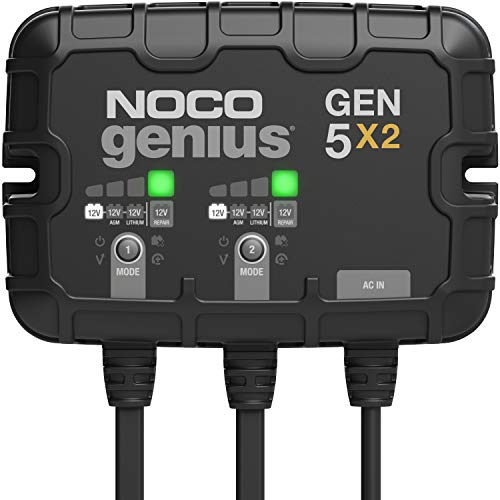
NOCO GEN5X2 12V 10A 2-bank onboard charger
$139.95 Published specsTwo banks at five amps each, for a 24 volt motor bank charged as two separate 12 volt batteries.
Check price on Amazon
ProMariner ProSport HD 8A 2-bank waterproof onboard charger
$154.85 Published specsGenuinely waterproof rather than water resistant, which is the difference in a bilge that gets wet every trip.
Check price on Amazon
ProMariner ProSport HD 12A 2-bank waterproof onboard charger
$191.50 Published specsTwelve amps over two banks, and the ProSport HD is the charger most often fitted as original equipment on new boats.
Check price on Amazon
Minn Kota MK 330 PC precision charger, 3 bank 10 amps
$199.00Thirty amps over three banks from the company that made the motor, which removes any compatibility argument.
Check price on Amazon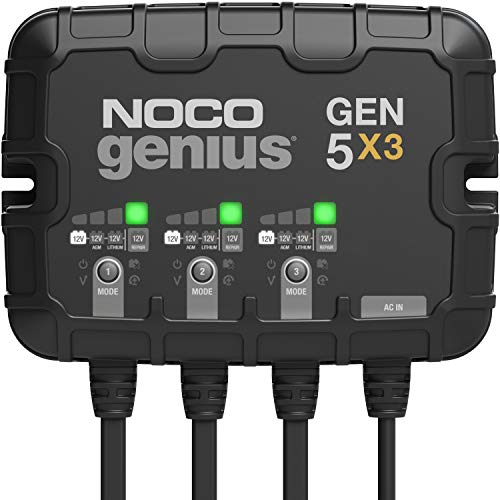
NOCO GEN5X3 12V 15A 3-bank onboard charger
$199.95 Published specsThree banks for a 36 volt motor, and the cheapest three bank charger in this catalog by a clear margin.
Check price on Amazon
NOCO GENPRO10X2 12V 20A 2-bank onboard charger
$224.95 Published specsTen amps per bank rather than five, which halves the overnight recharge time on a 100 Ah bank.
Check price on AmazonHow we chose
We did not test this equipment in person and we never claim to. Picks are researched from manufacturer specification sheets, published engineering and regulatory figures, and the recurring themes in verified owner reviews. Every pick is matched to a real thrust rating, a real published amp draw, a real capacity or a real conductor size rather than to a price bracket, and it is placed in the tier where its published capability actually belongs. We rejected the unbranded flood that dominates several of these search results, because a lithium pack whose management board is the only thing between a cell fault and a fire, a breaker protecting a battery cable, a life jacket and a bracket holding a two thousand dollar motor to the bow at highway speed are all parts whose failure has a consequence nobody can walk away from. Where a figure is convention rather than a published standard we label it that way, and where a manufacturer does not publish a figure we leave it out instead of estimating it.
Frequently asked questions
What size charger does a 120 Ah battery need?
Roughly 15.6 amps per bank on lead acid, which is the ten to thirteen percent of capacity convention and rounds up to a stocked 20 amp output. A LiFePO4 pack of the same capacity will take considerably more, commonly up to half its capacity, though 25 amps is a comfortable onboard figure that does not need a large unit.
Is the charger rating per bank or in total?
Per bank, and this trips people up constantly. A three bank ten amp charger delivers ten amps to each of three batteries, which is thirty amps in total. Manufacturers frequently market the total, so a charger sold as thirty amps may be ten per bank. Size the per bank figure against one battery capacity, not the total against the whole bank.
Can a lead acid charger charge a lithium battery?
Not safely and often not fully. A lead acid profile ends in an absorption and float stage at a voltage a LiFePO4 pack should not be held at, and many lead acid chargers never reach the bulk voltage lithium needs, so the pack sits permanently part charged. A charger with a lithium profile is not an upgrade, it is a requirement, and chargers that have one say so.
How long will a full recharge take?
On lead acid at 20 amps per bank, putting back a half discharged 120 Ah battery takes roughly 3.5 hours, and the real figure runs longer because the final absorption stage is slow regardless of charger size. Lithium at 25 amps puts back eighty percent of the same capacity in about 4.0 hours and does not slow at the end.
Do I need a charger bank for the cranking battery?
It is worth having. An outboard alternator charges the cranking battery while you run, but a day of electronics on a trolling motor bank with the engine off leaves it untouched, and a starting battery that has been sitting is the classic reason a boat will not start at the end of a good day. A four bank charger for a 36 volt motor plus the starter is the usual full boat setup.
Onboard charger or a portable one?
An onboard charger is permanently mounted, wired to each battery and waterproof, so charging is plugging in a shore cord and nothing else. A portable charger is cheaper and means clipping leads to each battery in turn, which is fine once and tiresome every week. The onboard unit is also the only realistic option once batteries are buried under a deck.
Get the complete rigging shopping list
Every item in the beginner, intermediate and expert rigs for both a boat and a kayak, with running totals, in one printable list. No charge.
One list, no sequence of daily emails, and you can leave at any time.
Researched, not professional advice. This page is compiled from published engineering and regulatory figures, manufacturer specifications and owner-review consensus, not hands-on testing. Figures described as a rule of thumb are boating convention rather than published standards, and they are labelled that way wherever they appear. Marine electrical work is not house wiring. Use tinned, finely stranded marine cable, size it for voltage drop and for the ABYC E-11 ampacity table rather than one or the other, and put overcurrent protection within seven inches of the battery positive terminal, because everything between the post and the fuse is unprotected. A lithium battery needs a charger with a lithium profile. Never load a boat past its capacity plate, and remember that canoes and kayaks carry no federal capacity plate at all, so their stated capacity is the manufacturer own figure. Wear the life jacket, and treat early season water as the hazard it is: cold water immersion takes your breath and then your hands long before it takes your core.